


Japan's Hydrangea Temples: Where the Rainy Season Blooms with Color


When people think of seasonal flowers in Japan, cherry blossoms are usually the first to come to mind. But once spring fades and the rainy season arrives, another flower takes center stage: the hydrangea. Known as ajisai (紫陽花, アジサイ) in Japanese, these soft-hued flowers transform temple grounds, mountain paths, and gardens into colorful landscapes that celebrate the beauty of early summer.
Blooming from June to July, hydrangeas are among Japan’s most beloved seasonal flowers. Their peak season coincides with the rainy months, when many travelers assume there is little to see outdoors. While this period may see fewer flowers than spring, hydrangeas brighten the season with their abundance and ever-changing shades of blue, purple, pink, and white, creating spectacular displays that linger for weeks.

Why Are Hydrangeas So Special?
Japan is home to more than 100 varieties of hydrangeas. Some bloom in large, rounded clusters, while others feature delicate flowers surrounding a central patch. Because they are relatively easy to grow, hydrangeas can be found throughout the country in parks, temple gardens, and private homes. Although the exact blooming period varies depending on temperatures and the variety, hydrangeas generally stay beautiful for three to four weeks, making them one of the longest-lasting seasonal flowers.
But what makes hydrangeas especially fascinating is their color. If you've ever noticed blue, pink, purple, and white hydrangeas growing side by side, there's a simple explanation: soil acidity. More acidic soil tends to produce blue flowers, while more alkaline soil encourages pink blooms. In some cases, a single hydrangea bush can even display several different shades at once.
According to popular tradition, each color also carries its own meaning:
Blue – regret, gratitude
White – innocence, honesty
Pink – affection, sincerity
Purple – elegance, wisdom
These colorful blooms and their symbolism are just one of the many reasons hydrangeas have become such a beloved part of Japan’s early summer season.

A Flower with More Than a Thousand Years of History
Hydrangeas may be best known as a symbol of Japan's rainy season, but their history stretches back more than a thousand years. References to these flowers can be found in the Man'yoshu, Japan's oldest collection of waka poetry from the Nara period (710–794), showing just how long they have been admired across the country.
Throughout history, hydrangeas have carried a variety of meanings. Their ability to change color according to weather and soil conditions led many people to associate them with change and uncertainty. At the same time, their ability to bloom beautifully year after year made them symbols of eternity, resilience, and lasting bonds.
During the Edo period (1603–1868), some samurai even viewed hydrangeas as symbols of immortality. Over time, the flowers became common motifs in kimono designs, paintings, jewelry, and other forms of art. Today, they remain deeply woven into everyday life and traditional Japanese culture.
While hydrangeas have long been appreciated as garden plants, the idea of visiting large-scale hydrangea displays is surprisingly recent. Before the decades following World War II, there was little tradition of gathering to admire vast clusters of hydrangeas.
That changed thanks to one temple in Kamakura. Meigetsuin became famous for its stunning hydrangea displays and helped popularize what would later become known as Ajisai-dera, or “Hydrangea Temples.”
As interest in hydrangeas continued to grow, other temples began cultivating large gardens of their own. Today, visiting hydrangea spots has become one of Japan’s most beloved early-summer traditions, alongside cherry blossom viewing in spring and autumn leaf viewing in fall.

Legends and Stories Behind the Flowers
Part of what makes hydrangeas so fascinating is the number of stories and legends associated with them. Many of these tales revolve around emotions, relationships, and heartfelt apologies.
One of Japan’s most famous legends tells of an emperor who neglected the woman he loved because he was too focused on his official duties. To express his regret, he presented blue hydrangeas to her family as a sincere apology. Because of this story, blue hydrangeas are often associated with gratitude, understanding, and remorse.
Not all stories about hydrangeas are romantic, however. During Japan’s feudal era, some members of the warrior class viewed the flowers with suspicion because of their constantly changing colors. They were sometimes known as Nanahenge (七変化), or “seven transformations,” a name inspired by their tendency to change color throughout the season.
Hydrangeas also have a story that reaches beyond Japan. According to legend, a courtesan from Nagasaki gifted the flowers to her lover, the German physician and botanist Philipp Franz von Siebold. Captivated by both the woman and the flower, he later introduced hydrangeas to Europe, helping spread their popularity overseas.
Whether viewed as symbols of apology, devotion, or transformation, hydrangeas continue to carry a sense of emotion that makes them especially fitting for Japan’s rainy season.
Famous Hydrangea Temples in Japan
If you would like to experience the beauty of hydrangeas for yourself, several locations across Japan are particularly famous for their stunning displays. Here are a few of the country's most famous hydrangea temples:

Meigetsuin Temple (Kanagawa)
Known as the "Hydrangea Temple," Meigetsuin is famous for its beautiful blue hydrangeas that bloom every June during the rainy season. Beyond the flowers, the temple is known for its long history, moon-themed symbolism, and connections to local rabbit folklore. It is also closely tied to the Kamakura period and the influential statesman Hojo Tokiyori, making it a fascinating destination for both flower lovers and history enthusiasts.

Hattori Hydrangea House (Chiba)
Tucked away in the countryside of Chiba, Hattori Hydrangea House is a hidden gem that comes to life from early June to early July. What looks like an ordinary farmhouse reveals a hillside covered in more than 10,000 hydrangeas, creating a sea of colorful blooms in every direction. With hundreds of varieties spread across the slopes, it's a peaceful place to experience the beauty of hydrangea season up close.
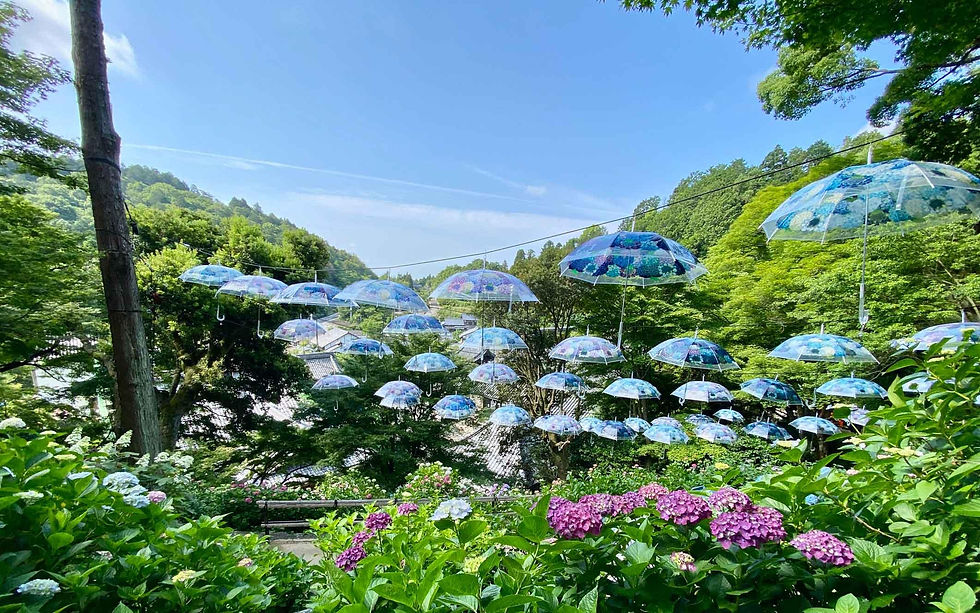
Yanagidani Kannon Yokoku-ji Temple (Kyoto)
Nestled on a mountainside near Kyoto, Yanagidani Kannon is one of the city's most popular hydrangea destinations. Throughout June, the temple grounds are filled with around 5,000 hydrangeas in bloom, creating a colorful backdrop for its annual Hydrangea Week. Visitors can admire beautifully decorated water basins filled with floating hydrangea petals, collect special seasonal goshuin (temple stamps), and take home flower-themed omikuji (fortunes).

Minamizawa Hydrangea Mountain (Tokyo)
For those looking to venture beyond temples, Minamizawa Hydrangea Mountain is a hidden gem well worth the trip. From mid-June to early July, the mountainside comes alive with thousands of hydrangeas, transforming the forest trails into a sea of colorful blooms. As visitors follow the winding paths through the hills, they're treated to stunning views of flowers cascading down the slopes alongside a mountain stream.
What makes this place even more remarkable is how it came to be. More than 50 years ago, local resident Chuichi Minamisawa planted just a few hydrangeas along a path leading to his family cemetery. Over the decades, his passion and dedication transformed the entire mountainside into the breathtaking destination visitors enjoy today.

Enjoying Japan’s Rainy Season in Full Bloom
While the rainy season may not seem like an obvious time to travel, hydrangeas reveal a different side of Japan's beauty. Their vibrant colors brighten misty landscapes, temple grounds, and mountain trails, creating scenes that feel almost magical after a rainfall. Steeped in history, symbolism, and centuries of tradition, these beloved flowers have become one of Japan's most treasured signs of early summer. Whether you're visiting a famous hydrangea temple or discovering a hidden garden along the way, hydrangeas offer a beautiful reminder that even the rainiest days can be filled with color.
Picture Sources:
https://www.chikyudori.com/wp-content/uploads/2020/07/D854531-Edit.jpg
https://mag.japaaan.com/wp-content/uploads/2021/06/ajisaiart-1280x720.jpg
https://enokama.jp/wp-content/uploads/2023/05/pl-999206781109-1024x681.jpg
https://www.visitchiba.jp/wp-content/uploads/2021/07/20240513_HattoriHydrangeaHouse1.webp
https://www.nippon.com/en/ncommon/contents/japan-topics/1855462/1855462.jpg
https://d2tzd06cwmvahj.cloudfront.net/wp-content/uploads/2022/06/29104530/Hydrangea_02-min.jpeg
Sources:
https://japanstartshere.com/2024/07/08/hydrangea-season-in-japan/
https://travel.rakuten.com/contents/usa/en-us/guide/hydrangea-japan/
https://japan-forward.com/ajisai-colors-and-patterns-that-brighten-japans-rainy-season/
https://mktaxi-japan.com/kyoto/articles/meigetsuin-is-japans-first-temple-known-for-its-hydrangeas/
https://www.thewanderingcam.com/destinations/hydrangeas-wonderland-chiba-japan
https://multi.andtrip.jp/LUC2AITRIP/cdata/luc2aitrip_2004_jaen.html
https://japancheapo.com/events/kyoto-yanagidani-kannon-hydrangea-week/
https://japantravel.navitime.com/en/area/jp/guide/NTJtrv1521-en/


コメント