


Jigokudani Monkey Park

About 70% of Japan is mountainous. These mountains have snow, onsens, and even monkeys that bathe in the onsens. Since 1964, the Jigokudani Monkey Park, also known as the Wild Snow Monkey Park, has been a habitat for the Japanese macaques and has become a must-see tourist attraction.

Japanese Macaques
The Japanese macaques, most commonly known as snow monkeys, are native to Japan. They are mainly found on Honshu (the main island of Japan), Kyushu, and Shikoku. Snow monkeys can be easily distinguished by their red faces and bottoms. Like most primates, snow monkeys travel in groups and are omnivorous. Unlike most monkeys, snow monkeys are one of two species known to reside in cold, mountainous regions.
“Beloved since ancient times, Japanese macaques have appeared in many folk tales and historical incidents. Carved representations of the three wise monkeys, demonstrating the lesson that we should refrain from wrongdoing based on the rules of “See no evil,” “Hear no evil,” and “Speak no evil,”1 are also to be seen at Nikko Toshogu2 Shrine in Tochigi Prefecture” (Public Relations Office: Government of Japan, 2026).
Snow monkey haven
The Jigokudani Yaen-koen is located in the Valley of Yokoyu River, which takes its water from Shiga-Kogen of the Jyoshinetsu-Kogen National Park in the northern part of Nagano prefecture. Looking at the very steep cliffs and the fountains of hot water, people started to call the valley ‘Jigokudani (Hell valley)’. The altitude is 850 meters. Winter seasons in Jigokudani are so harsh; for example, temperatures drop to 10 degrees below zero, and snow falls over 1 meter. These severities compare favorably with those of the Shimokita Peninsula (Aomori pref.), which is the northernmost habitat of primates except humans (Jigokudani Yaen-koen).

According to the Public Relations Office: Government of Japan, the catalyst for creating Jigokudani Monkey Park came from an idea to protect the snow monkeys and local farms. This idea came from Shogo Hara, who later became the first director of the Jigokudani Monkey Park. After WWII, with many changes to the forestry industry, the forests where the snow monkeys resided were being affected by deforestation.
As a result, many monkeys began to descend the mountain in search of food. “Fearing that this would lead to the monkeys being exterminated, Shogo Hara, the first director of Jigokudani-Yaen-Koen, came up with a plan. He started feeding these displaced monkeys in an area deep within the mountains, away from the apple farms. He believed that, if they could just find enough food to eat in the mountains, the monkeys would not resort to ransacking farms” (Saiyu Travel).
Hara and locals who shared his sentiment began feeding the monkeys while successfully leading them away from the village. It was then that they considered the possibility of using the monkeys to generate tourism to the area. During their close contact with the snow monkeys, Hara and the locals noticed that the monkeys would bathe in the onsen. Unsure of whether this was a natural phenomenon or the monkeys imitating the guests at the nearby onsen, the idea to turn this into a tourist attraction was set in stone.
In 1964, the Jigokudani Monkey Park officially opened, and by 1967, the outdoor onsen for the exclusive use of the snow monkeys was finally complete. While the park had visitors, the popularity that we know started with a photograph in the American magazine LIFE in 1970. This photo, “Snow Monkeys of Japan”, created a buzz around the park, and the coverage it received during the 1998 Nagano Winter Olympics solidified it as a tourist attraction.

Visiting Jigokudani Monkey Park
Since 1964, the Jigokudani Monkey Park has provided a safe place for the snow monkeys and humans to interact without causing the monkeys to be dependent on humans for survival. A 30 to 40-minute walk from the Kanbayashi Onsen parking lot or the designated bus stop, the monkey park is said to be worth the trek.
It is open year-round, with hours varying slightly between seasons:
Summer season (Apr.–Oct.)
8:30 a.m.–5:00 p.m.
Winter Season (Nov.–Mar.)
9:00 a.m.–4:00 p.m.

If you are interested in visiting the monkey park, please read the park’s official First-Time Visitor’s Guide:
1. Time Your Visit Accordingly
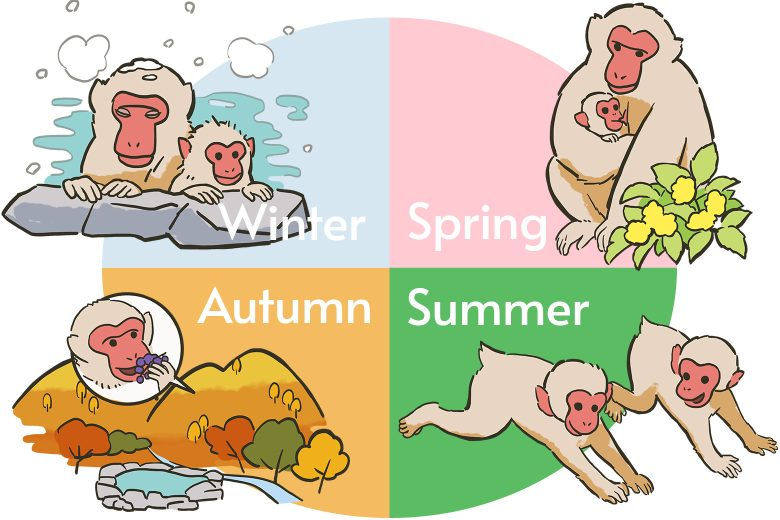
The snow monkeys use the park’s hot spring baths from December to March, when the weather is coldest.
They give birth during the spring, when you can sometimes see adorable baby monkeys.
Food sources are plentiful in the mountains during the fall, so monkeys may not stop in at the park every day.
2. Check Monkey Information for Your Planned Visit Date
Park staff posts information on monkey conditions daily via Facebook and X (Twitter). Check these accounts to see if monkeys will be present on your planned visit date.
3. Travel to the Park
A dedicated parking lot is available if you plan to come by car, and buses are available if you plan to use public transportation. You must walk for about 30 minutes along an unpaved path from the parking lot or bus stop to the park, so make sure to wear appropriate footwear for mountainous walking conditions. We recommend hiking shoes in the summer and snow boots or similar in the winter. Buy simple crampons in advance for a safer and more enjoyable visit in the winter.
4. Check the Rules Before Entering the Park
Observe the snow monkeys from a distance, without upsetting or scaring them.
Photography is allowed, but the use of selfie sticks and other unorthodox photography methods are prohibited, as this kind of behavior will surprise the monkeys.
Please read the monkey observation tips and rules in advance to enjoy your experience more fully.
5. Observing the Monkeys
Observe the snow monkeys from a distance, without upsetting or scaring them.
Photography is allowed, but the use of selfie sticks and other unorthodox photography methods are prohibited, as this kind of behavior will surprise the monkeys.
Please read the monkey observation tips and rules in advance to enjoy your experience more fully.

6. Visit the Gift Shop
Before leaving the park, make sure to stop by the informational display area and gift shop.
If the Jigokudani Monkey Park seems interesting to you, remember to follow the park’s instructions and prepare yourself for cute baby monkeys. 🐒

LINKS USED


コメント