


Showa no Hi

What was life like in the Showa area? How did people have fun when they didn’t have the internet, computer, and cell phones like we do now? It might be hard to know unless you actually talk to someone who lived in that era, or visit museums that show you what life was like. To celebrate this year's Showa no Hi, the day to remember the past, let’s put the two together where I was able to listen and see little bits of a day in the life of someone who lived in the Showa era.

The Showa era started with Emperor Hirohito, also known as the Showa Emperor. Showa (昭和)also meaning “enlightened (昭 ) peace (和)” was given this era name, between 1926-1989, to mark the emperor’s strong leadership to recover economically after World War II. When the era changed to Heisei (平成), the Emperor’s birthday, April 29, was renamed みどりの日 (Midori no Hi), Greenery Day, to recognize the previous Emperor’s love of nature, but was later changed to 昭和の日(Showa no Hi) to remember the past, while Midori no Hi was moved to May 4.
The Showa era came with many hardships, especially after World War II. This was especially so to Japanese descendants who were born and/or raised in the United States. Let’s take an example from a second generation American-Japanese, we will call her Ei-chan. Ei-chan was a young lady in her late teens when she had to move to Japan after the war. Her life in Japan was really rough and came with a lot of hardships.
There were days where there was not enough food since food was scarce. In order to make money, she would have to walk to the ocean to gather ocean water multiple times a day so they were able to make enough salt to sell in the city. During her time at school, she was also bullied quite a bit since she was pretty tall for a Japanese woman during that time and her Japanese was not perfect since it was her second language. She experienced many hardships and went back to the states, leaving nothing but a salty taste in her mouth.
Ei-chan’s story is just one story that was told and there should be many other different versions out there. Listen to their story and they will tell you about the good things and hardships that came with living in Japan during the Showa era.
Let’s take another look at a different life. Let’s call her Taka-chan. Taka-chan was born and raised in Japan. She was a young child during the war and when it ended so she doesn’t really remember that time. What she did remember was that her mother was very strict and would tell her that she should focus on studying. There was one time where she borrowed a manga from a friend, since her mother would not purchase one for her. Her mother found the manga and threw it in a fire in front of Taka-chan, reminding her that studying was more important than manga.
Since Taka-chan was also the oldest daughter she also had to take care of a lot of household chores from the early age of 8 (2nd grade), along with cleaning her younger sibling’s dirty diapers by walking to the nearest river to rinse out the fecal matters. During this time, Taka-chan would be able to take a break from her studying and chores to sneak in manga reading time. Some of the fun activities she remembered was getting 1 yen to buy small little snacks at the 駄菓子屋、(だがしや=Dagashiya) snack shop.
What are your thoughts about these stories? Would you be able to survive during this era?
It might be a bit difficult for me to live during that era if I knew what I have now, but looking at the items and what a life during that time was like was a fun experience.

In a small 温泉, onsen (hot spring), town called Yufurin, located in Oita, I visited a Showa museum. The entrance of the museum was a modern Dagashiya. The shop had lots of nostalgic snacks as well as modern snacks and trinkets as well. The register was also the entrance of the Showa Museum. Entrance fee for the museum was ¥1400 at the time for an adult. Once you enter the museum, you are instantly time warped in the Showa era where the first room you can visit is a classroom. The wooden desks lined up in rows and columns shows that the setting hasn’t really changed too much to what it is like presently. Familiar items that current classrooms now still have but have a more modern and new look.
“This is just as I remembered, back when I was in school,” Taka-chan said as we took a look around the classroom. “Our school backpacks were a lot smaller than they are now. Kids these days carry so much more stuff.” Nostalgia hit Taka-chan as we started to continue down our path of the Showa era.

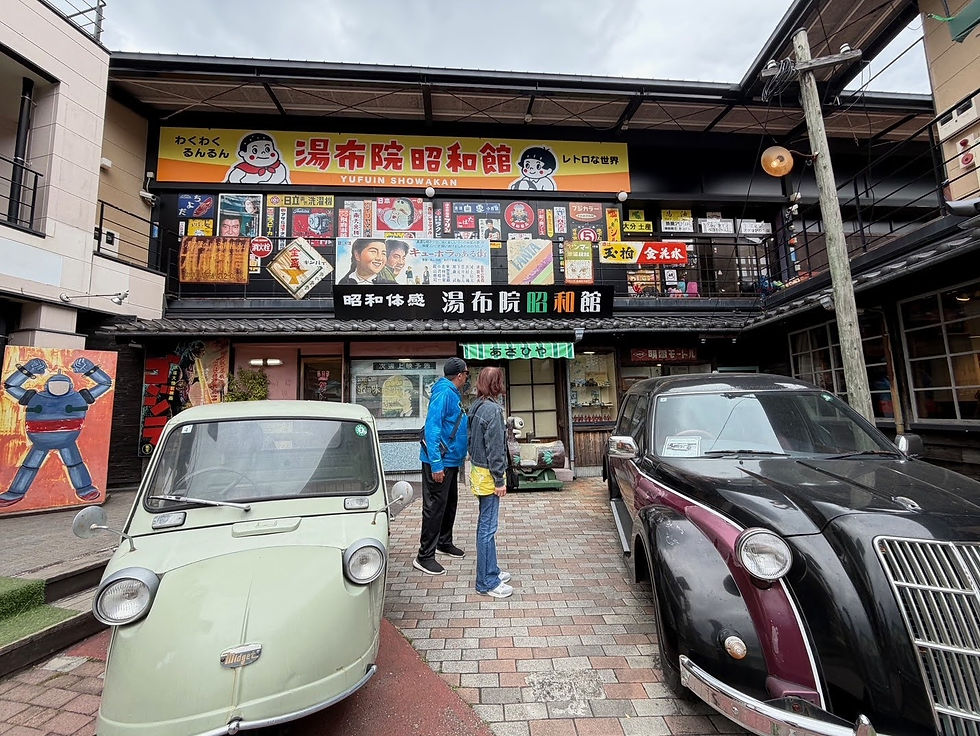
Walking through the museum, we wandered into various themed rooms. Each room captures the essence of daily life during its time. The museum as a whole gave a good nostalgic feeling to those who lived in the era, while it gave the newer generations a glimpse of the past and noticing what has changed and what continues to thrive to this day.
We walked into a living room where a small black and white TV was playing a show, a small dining table for everyone to sit on the tatami floor.

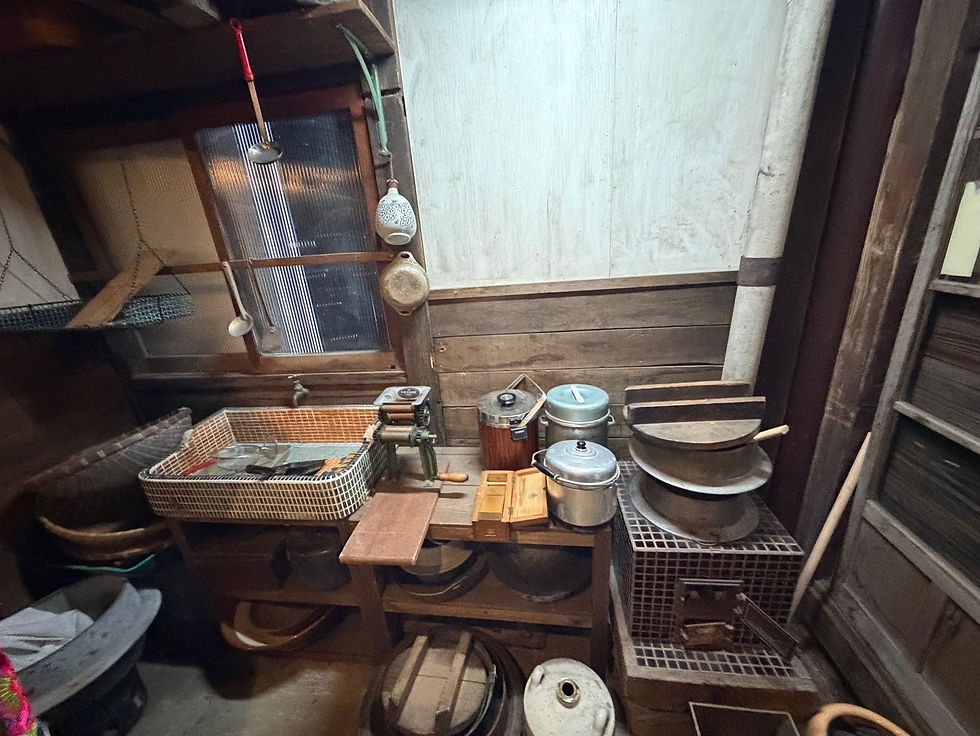
Connected to the living room was the kitchen. Showed how they would prepare and cook their meals in a small area that was slightly separated from the inside of the house where they would make the rice or even noodles. The one item in the house that Taka-chan was glad was no longer in houses were the squat toilets. These toilets were usually set up outside of the house in its own small room connected by a small walkway. I think, if I was to use the toilet during the summer or the winter I would try to do my business as quickly as possible since in winter it would be really cold to to leisurely relieve myself, while in the summer, the hot weather would make a small room smell rancidly and quickly.

The overall experience in the Showa museum was eventful and memorable. Even after we left the museum, Taka-chan and I continued to talk about the museum and how fun it was to try various hands-on activities the museum provided like, Pachinko, vintage arcade games, vintage video games, and festival games that are still being played today by the younger generation. It showed us that some activities continue to entertain everyone no matter what generation they are. If you are ever in Yufurin, Oita, please visit this museum and get blasted back to the past. There are other locations for the Showa museum around Japan that you can visit too.
Sources:
Pictures: Photo provided by Kim


コメント