


Japanese Zen Gardens: The art of tranquility

What are Zen Gardens?
When mentioning Zen Gardens, the most popular image that pops into people’s minds is the minimalist garden with large stones and neatly raked sand. These types of gardens are called Karesansui (枯山水), with kare (枯) meaning dry, and sansui (山水) meaning mountain and water, respectively. This style of garden is also known as Japanese Dry Garden, or commonly referred to as Zen Gardens.
Despite the inclusion of water in the name, Karesansui gardens are minimalist, dry landscape gardens, mostly consisting of sand, rocks or gravel and small greenery like moss and shrubs. These gardens are designed to be appreciated from a seated, meditating position and not to stroll through like other types of Japanese gardens.

Principles of Zen Gardens
Zen Gardens follows the idea of Zen philosophy, a school of Buddhism that emphasizes the importance of meditation in achieving spiritual awakening. Zen philosophy believes that each person has a Buddha within them, and one could reach their inner Buddha by letting go of their earthly desires, as it is the root of all suffering on earth. For this reason, Zen gardens are designed to be a place where monks can practice meditation to achieve enlightenment, either by sitting meditation or maintaining the garden.
Zen gardens are also influenced by the principle of Wabi-sabi (侘び寂び), a traditional Japanese concept that focuses on the beauty of imperfection and the acceptance of transience. Wabi (侘), meaning the beauty in austerity, and Sabi (寂), which means the beauty that comes with age. This principle is also present in many other Japanese practices, such as Japanese Flower Arrangement, Tea Ceremonies, Ink paintings, Calligraphy, and many more.
Elements of Zen Gardens
Karesansui garden’s most notable feature is its simplicity. The construction of the garden creates an abstract imitation of the natural world. Hence, it has only a few elements: rocks or stones, gravel or sand, and minimal greenery.
Stones are primarily the centerpieces of these gardens. They have several different arrangements and can represent mountains, hills, animals, or religious entities. Rocks and stones can also be arranged to invoke the image of waterfalls called Karedaki (枯滝), literally translated to “dry waterfall”.
The surface of the garden is often covered with white sand or gravel, which is raked by monks as a meditation practice. This particular technique of raking is called Samon (砂紋), where uniform patterns are created in the sand, usually to imitate water ripples or flow, but can also be abstract geometric patterns that invoke calmness.

And last but not least, the green elements of the garden: moss, shrubs, or wood. Karesansui gardens often have very minimal greenery; the most common thing you can find is moss, usually at the bases of the stone arrangement. These help reduce maintenance for the garden and ensure visual coherence throughout the seasons.
History
Heian Period (794 - 1185)
Rock gardens existed as early as the Heian period in Japan, described by the Sakuteiki (作庭記), the first record of garden keeping written in the 11th century. These rock gardens often serve as subsections in larger garden spaces, which were mainly extravagant pond gardens called Shinden (寝殿) gardens, a style influenced by Chinese models, and developed during the Nara period (710 - 794). They were luxurious spaces in aristocratic estates, with large ponds and courtyards, surrounded by lush greenery. These spaces are designed for parties and entertainment activities like boating for the upper class in the Heian Period. No Heian-era estate exists in its original condition, but many of these gardens were incorporated into other types of Japanese gardens that came after, such as tea gardens or stroll gardens.
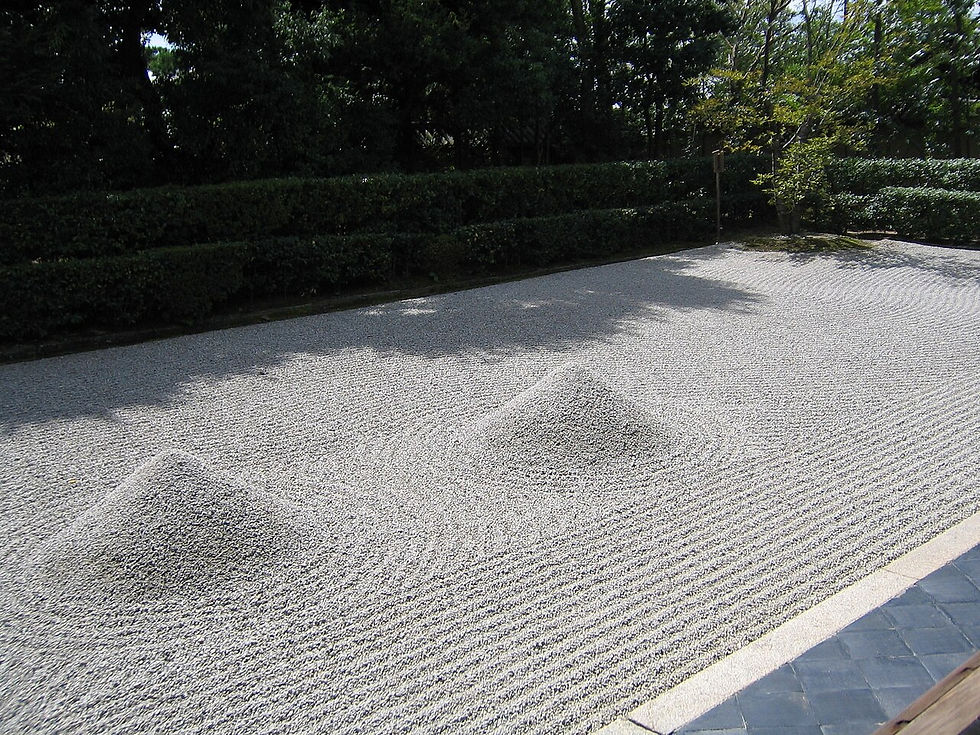
Muromachi Period (1336 - 1573) Japanese Zen Gardens
By the end of the Heian period, power had begun to shift into the hands of the militaristic Samurai class, and Zen Buddhism was being introduced into Japan and widely adopted by the Samurai. By the 13th and 14th centuries, Zen Buddhism was widely spread among the aristocratic society, and its philosophy has greatly influenced garden design.
The idea of the minimalist, meditative Karesansui gardens, similar to ones we see in modern day, developed during this time. These gardens also shift from being a sub-section of larger gardens to becoming a dedicated space of their own. Gardens were often built attached to temples as they served as spaces for monks and masters to meditate and practice their religion. Imperial leaders at the time also considered the principles of Zen Buddhism in high regard, so Karesansui gardens were also built in the Imperial Court and estates.
Modern Day
There are many Karesansui gardens that still exist in temples and shrines all throughout Japan today, as well as in private estates. Many places in the world outside of Japan also have Zen Gardens, such as the United States, England, and New Zealand. Some notable gardens are the Portland Japanese Garden in Oregon and the Seattle Japanese Garden in Washington in the United States; the Zen Garden in the Saint Mungo Museum of Art in Glasgow, Scotland; and the Japanese Garden of Contemplation in Waikato, New Zealand.
The Portland Japanese Garden is a garden space that features 5 different Japanese garden styles, including a Karesansui garden. It was built in the 1960s and 70s, and designed by Professor Takuma Tono of Tokyo Agricultural University. The garden has an area of 5.5 acres and has not only many gardens, but also teahouses and many spaces to host exhibitions and cultural events.

Nowadays, there are also mini model kits of Zen Gardens available for purchase to use as decoration in the workspace or at home. The kits usually come with stones and other elements to design your own garden, as well as rakes for you to practice meditation and mindfulness while maintaining your miniature garden.

Notable Zen Gardens in Japan
Most notable Zen gardens are in Kyoto, as it used to be the old capital of Japan before Tokyo. Other gardens can also be found in Wakayama, Kamakura, and other prefectures of Japan.
Ryoan-ji (龍安寺) Temple, Kyoto
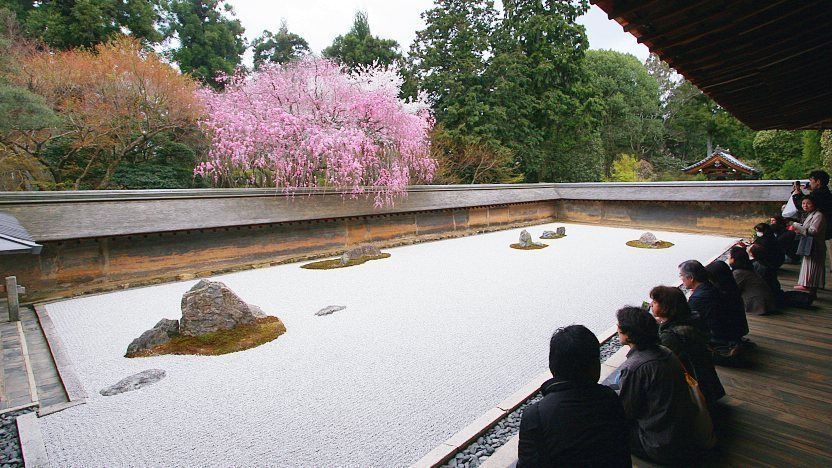
The most famous Karasansui garden is located within the Ryoan-ji (龍安寺) Temple in Kyoto, Japan. The temple was an aristocratic villa that was converted into a Zen Buddhist temple in the Muromachi period in the 15th century. It was recognized as a Historic Monument of Ancient Kyoto and a UNESCO World Heritage Site in 1994. The stones in the garden are positioned in a way that only 14 out of the 15 stones are visible at any given angle, and it is said that all of them can only be seen once you reach enlightenment.
Daitoku-ji (大徳寺) Temple, Kyoto
Daitoku-ji Temple is located in Kyoto’s Sagano district. It was built in the 14th century and contains dozens of sub-temples. This temple serves as the head temple for the Rinzai sect of Zen Buddhism, and many of its temples have very notable examples of Zen Gardens. One such example is the Daisen-in temple, which features Karesansui gardens inspired by Chinese landscape paintings. Another sub-temple with Karesansui gardens is the Ryogenin temple, which contains as many as 5 Karesansui gardens surrounding its main hall.
Kongobu-ji (金剛峯寺) Temple, Koyasan
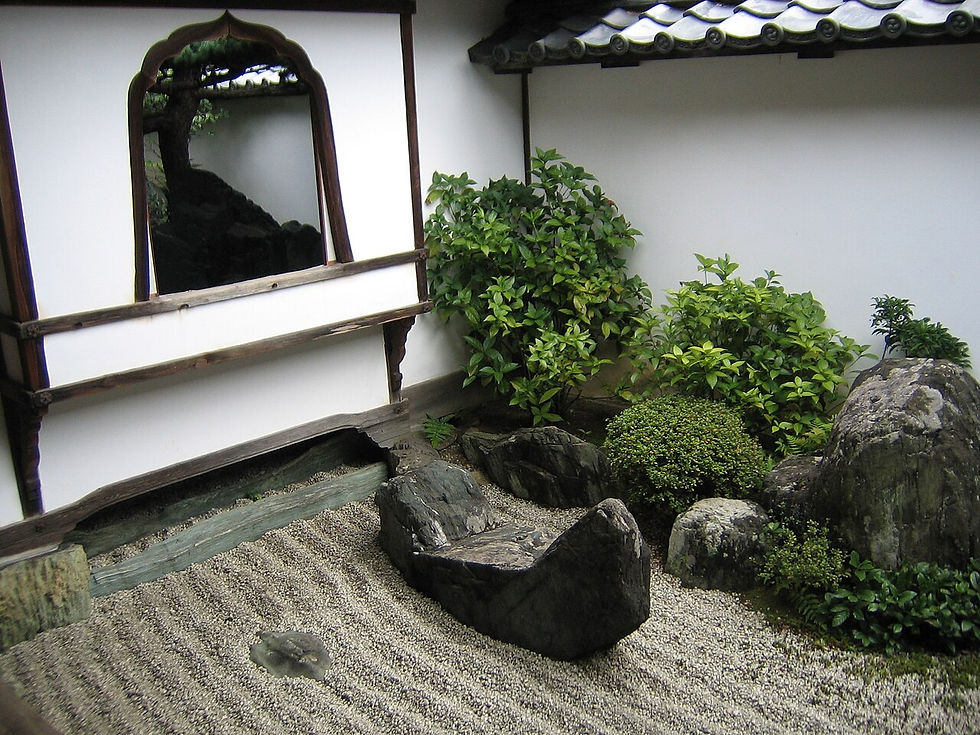
Kongobu-ji Temple is located in Koyasan (Koya Mountain), and it is the head temple for the Shingon Buddhism sect. It was built in the 16th century by Toyotomi Hideyoshi, a Japanese General, to commemorate the death of his mother. Kongobu-ji is home to the largest Karesansui garden in Japan, the Banryutei Rock Garden. It covers an area of 2,340 square meters and features 140 large stones, representing a pair of dragons rising from the clouds to protect the temple.

Gardens in Tokyo
In the heart of the bustling, lively city of Tokyo, there are still many natural gardens that provide people with an escape from the noisy city. These gardens were often estates of aristocrats or private gardens of Shoguns, which were turned into public gardens by the Tokyo Metropolitan Park Association. Examples include the Hama-rikyu Garden, the Kiyosumi Garden, and the Koishikawa Korakuen Garden. Many gardens are stroll gardens that offer lush greenery along with other natural elements like ponds and artificial hills, but do not feature many Karesansui gardens, or at least do not have one with its own dedicated space.

A Karesansui garden outside of the Nakajima Teahouse at the Hama-rikyu Garden, slightly disturbed by visitors
But outside of the Tokyo Metropolitan Area, there are a few places that have larger Karesansui gardens. One of these is the Gyokudo Art Museum. The museum is situated in Ome City, right by the Mitake Gorge. It is dedicated to Kawai Gyokudo (1873 - 1957), a famous Japanese painter who specializes in traditional Japanese Painting called Nihonga. Aside from the art exhibitions, it also features a Karesansui garden that won 7th place in the 2024 Japanese Garden Ranking by the Sukiya Living Magazine, a Japanese gardening magazine in English.

Final Remarks
Zen gardens are one of many types of Japanese gardens that have a rich history in Japan, but now appreciated by many people around the world. Even if you believe in Buddhist philosophy or not, Zen gardens are places for people to be able to slow down and reflect, or even just to appreciate the artistry and work that goes into creating and maintaining these gardens.
For more resources to learn about Zen gardens and Japanese gardens in general, the North American Japanese Garden Association (NAJGA) is a non-profit that focuses on educating and maintaining Japanese gardens in North America,with its members spread across the US and Canada. It is a good resource for English speakers to learn more about Japanese gardens. The Sukiya Living magazine also offers walking tours in Kyoto in the spring or fall, and it is a great way to learn about Japanese gardens, interior design, and culture.
Image sources
Bibliography


コメント