


Beyond the Stereotype: Understanding Geisha Through an Evening in Gion - byFood x GTJ Collaboration Experience
For generations, geisha have been romanticized, sexualized, and misunderstood outside Japan. Their image is instantly recognizable: white makeup, red lips, elaborate kimono, traditional hairstyles, and an almost mysterious femininity. Yet the more I learned during my evening in Gion, the more I realized that the visual image of a geisha represents only the surface of a much more complicated profession. What appears, from the outside, to be a highly stylized way of dressing is actually connected to years of training, artistic discipline, hospitality, etiquette, and a deep knowledge of Japanese tradition (Cowing, 2019).
My evening in Gion gave me the opportunity to move beyond the stereotype and encounter this world more directly. Instead of seeing a geisha simply as a beautiful, mysterious figure, I began to understand her as an artist, entertainer, hostess, and professional whose work depends on skills largely invisible to the tourist.
The central question I left with was simple: who are geisha really, and why have so many people outside Japan misunderstood them for so long?
The Geisha We Think We Know Beyond the Stereotype: Understanding Geisha
For many people outside Japan, the word “geisha” immediately creates a familiar image. We imagine a woman wearing an elegant kimono, her face covered in white makeup, her lips painted red, and her hair carefully arranged with traditional ornaments. She seems almost frozen in time: beautiful, mysterious, feminine, and somehow distant from ordinary modern life.

But that image comes with assumptions.
Western representations have repeatedly transformed the geisha into a symbol of an exotic Japan, often connecting her with particular ideas about Japanese femininity, beauty, and sexuality. Yoko Kawaguchi, who traces Western portrayals of geisha from the nineteenth century into modern popular culture, shows how images of geisha became intertwined with broader Western ideas about Japanese women and exotic femininity (Kawaguchi, 2010).
Historical encounters between Japan and the West added further layers to this image. Particularly during and after the Second World War, foreign visitors and servicemen encountered a Japanese social and entertainment culture whose distinctions were not always understood from the outside. Different roles occupied by Japanese women could consequently be grouped together under familiar labels, and the word “geisha” was sometimes used far more broadly than the profession itself warranted (Lee, 2022).
This was only one part of a much longer history of cultural misunderstanding, but it helped reinforce an image that already existed in the Western imagination.
This is what makes the geisha such an interesting cultural figure. She may be one of Japan’s most recognizable symbols, yet also one of its most misunderstood.
Before my evening in Gion, I knew that the stereotype could not tell the whole story, but I still had many questions. What actually makes someone a geisha? What does she do all day? Where did some of the assumptions surrounding the profession come from? How much of what we see is performance, and how much is simply part of a traditional way of life? And most importantly, what would I understand differently after actually encountering a geisha rather than simply seeing pictures of one?
My experience in Gion did not answer every historical question, but it changed the way I understood the person behind the stereotype.

What Is a Geisha?
The word “geisha” literally means an “arts person,” a meaning that immediately shifts the focus from appearance to skill (Cowing, 2019).
Geisha are professional entertainers trained in traditional Japanese arts and hospitality. Their training can include traditional performing arts, etiquette, tea ceremony, and the art of conversation itself (Cowing, 2019). They are entertainers, but they are also hosts. Their role is not simply to stand beautifully in a kimono. They are expected to create an atmosphere, interact with guests, perform, converse, and represent a long-established tradition.
In Kyoto, the terminology is more specific. A fully trained geisha is traditionally called a geiko, while a maiko is an apprentice who is still training to become a geiko (Cowing, 2019).
During the experience, I met a professional maiko, and the distinction became much more meaningful when I could actually see one in front of me. Our guide explained that maiko wear more colorful kimono, often decorated with flowers, while geiko generally wear less colorful, more mature clothing reflecting their status as experienced professionals. Suddenly, details that I might previously have seen simply as aesthetic choices communicated something about a woman’s place within the profession.

Training is a major part of this world. Girls traditionally begin around the age of fifteen, after completing junior high school, and training can last five or six years before they become fully fledged geiko (Cowing, 2019). This means that what a visitor sees during a short performance represents only a small part of a much longer process of learning and discipline.
The geisha world is also organized around houses known as okiya, where maiko traditionally live while they train and build their careers. Each house is managed by an okaasan, literally meaning ״mother״, who takes on a mother-like role toward the women in her care and oversees their lives within the profession. This position is closely connected to experience within the geisha world itself. After retiring from performing, some geiko go on to manage okiya or traditional teahouses, meaning that an okaasan may herself be a former geiko with years of experience and knowledge of the profession (Nishio & Kanai, 2007).
During the tour, I saw one of these houses. Small pieces of paper hanging there represented the maiko and geiko associated with that house. They are known as hanameishi (花名刺), or “flower name cards,” and display the professional names of the maiko and geiko associated with each okiya (geisha house). Our guide explained that the older-looking, smaller pieces represented women who had been associated with the house for longer, making even something as simple as a piece of paper a visible marker of experience.
These are not usually the Maiko’s and Geiko’s birth names. When a young woman prepares to make her official debut as a maiko, she receives a professional name chosen by the okaasan of her okiya (the mother of her Maiko and Geiko house). The name also often reflects her relationship with her senior mentor, also called oneesan, by sharing a written character with her name (The Kyoto Project, 2004). The professional name then continues to be used as she progresses from maiko to geiko.

One of the things I found fascinating was how much information was hidden in the details around us. Even the lanterns in the streets were part of this visual system: the lamps with white dots marked Gion, while other geisha districts were identified by different lanterns. Once I knew what I was looking at, the neighborhood felt less like a collection of beautiful traditional streets and more like a place whose details were telling me something about the world that existed there.
Kyoto has five traditional geisha districts, collectively known as the Gokagai, meaning “the five geisha districts”: Gion Kobu, Gion Higashi, Miyagawacho, Pontocho, and Kamishichiken (Kyoto City Tourism Association, n.d.).

The more I learned, the clearer one thing became: appearance is only the most visible part of the profession. Underneath the makeup and kimono is an enormous amount of training.
Where Did the Stereotypes Come From?
The misunderstanding surrounding geisha did not emerge from one single historical moment. Rather, it developed through a much longer process in which Western observers interpreted Japanese women and Japanese entertainment culture through their own cultural expectations.
Kawaguchi traces this process from the nineteenth century onward, showing how the geisha became part of a broader Western fascination with Japanese femininity. In Western representations, Japanese women, and geisha in particular, became connected with ideas about exoticism, beauty, mystery, and sexuality. These representations appeared across fiction, opera, visual art, theater, and later popular culture (Kawaguchi, 2010).
This matters because once the geisha became a cultural symbol, the symbol could begin to exist independently of the actual profession. Audiences did not necessarily need to understand what geisha were trained to do in order to recognize the image of the mysterious Japanese woman in a kimono.
The Second World War and the years that followed added another layer of confusion. During the Allied occupation of Japan, large numbers of foreign servicemen encountered Japanese society with limited knowledge of its cultural and professional distinctions. Terms associated with Japanese women and entertainment were sometimes used loosely, and “geisha” could become a convenient label for women who were not necessarily part of the traditional profession at all (Lee, 2022).
For Western audiences, this contributed to an already simplified understanding of the geisha. Rather than being recognized primarily through her artistic training and professional role, she could instead be absorbed into a much broader image of the exotic Japanese woman.
Yet the wartime and postwar period was not the origin of the stereotype. It was one chapter in a much longer history. Kawaguchi’s research demonstrates that Western fascination with and romanticization of the geisha had developed much earlier and continued across different forms of popular culture long afterward (Kawaguchi, 2010).
The result is a striking gap between image and profession.
The image emphasizes mystery, appearance, and exoticism. The profession I encountered in Gion emphasized training, performance, etiquette, hospitality, and discipline.
Understanding where the stereotype came from therefore matters not because it should define the story of the geisha, but because moving beyond it allows the profession itself to come back into focus.
Walking Through the World of the Geisha
Walking through Gion helped me understand how much the physical environment matters to geisha culture. The district is not simply a collection of picturesque streets designed for tourists. It is part of a living cultural environment in which geiko and maiko still train and work.

The lamps and signs are small details, but they make the district feel coded. Once our guide explained what certain visual elements represented, I started noticing things I would otherwise have walked past.
The world surrounding geiko and maiko is also highly structured. Their lives are connected to their houses, their training, the establishments where they entertain, and the expectations associated with their profession.

One of the most surprising things I learned was how far those expectations can extend beyond the actual performance. According to our guide, geiko and maiko are expected to maintain an image that is closely connected to tradition, and there are places they are not supposed to visit because they would be considered inconsistent with that image. We were told that this can include completely ordinary places such as Starbucks, 7-Eleven, or McDonald’s.
I found that fascinating because it showed me that the profession extends beyond the moment a maiko or geiko begins performing. The traditional image she represents is something she is expected to maintain in public as well.
That made the level of commitment involved feel much more tangible. Learning the dances, music, etiquette, and other skills is one part of the profession, but becoming a maiko or geiko also means entering a world with its own expectations about how that identity should be represented.
What initially looked like a profession built around performance began to seem much closer to a lifestyle shaped by tradition.
Meeting the Maiko
The first thing that struck me when I met the maiko was, of course, her appearance.
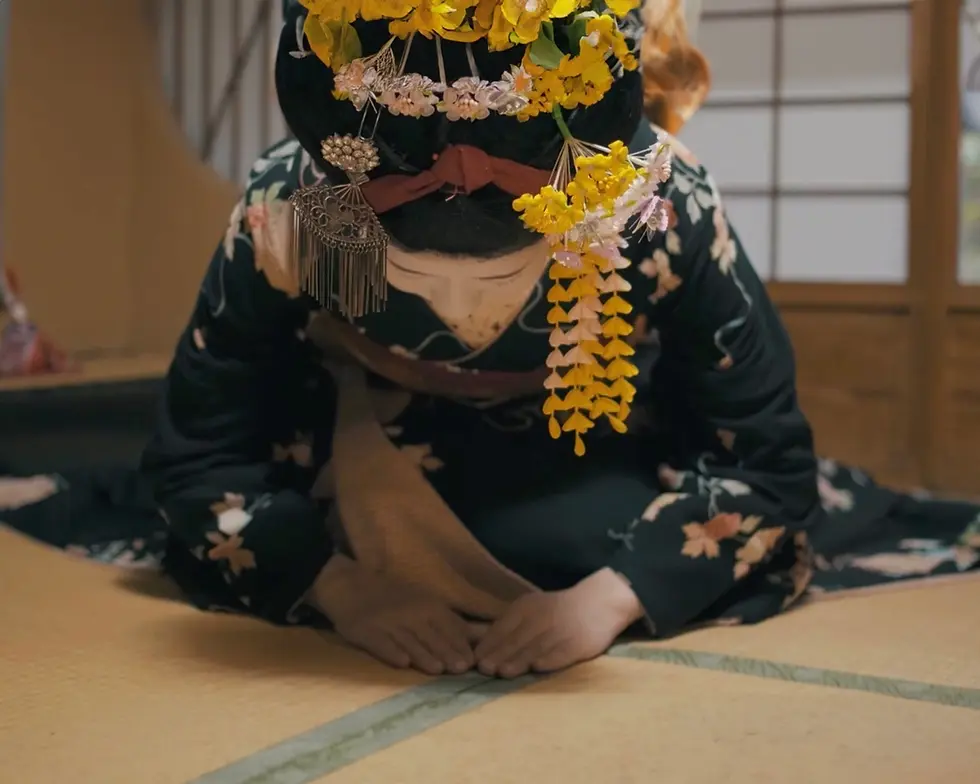
Her kimono was colorful and covered with floral elements, immediately distinguishing her from the more mature, restrained appearance our guide had explained was associated with a geiko. Her hairstyle was elaborate, and her makeup was carefully applied. Everything about her appearance looked deliberate.
But one of the most interesting parts of the experience was learning how much time and effort it takes to achieve this look.
She told us her hair alone takes around an hour to prepare, and once it's arranged, she leaves it that way for the entire week. It is treated with oil to help preserve it, meaning that she generally washes her hair only once a week. She even sleeps using a special pillow designed to protect the hairstyle.
She explained that her makeup takes approximately forty minutes. Dressing in the kimono takes about fifteen minutes for someone experienced, but she still needs help putting it on properly.
These details completely changed how I saw traditional appearance. Before, it was easy to see an elaborate hairstyle or a kimono as something beautiful but superficial. After hearing what maintaining them actually involves, I began to see them as part of the profession's discipline.
And then there was the performance itself.

A geisha’s work is not only about looking the part. Years of training go into traditional performing arts, etiquette, and conversation, all skills that are fundamental to entertaining guests (Cowing, 2019).
One comment from the maiko particularly stayed with me. She said that one of the things she likes most about performing is talking to people from different places around the world.
That answer immediately made her feel much less like the distant figure I had imagined when I first thought about geisha culture. She was not simply preserving something from the past. She was actively interacting with people from different countries in the present.
At the same time, she described the most difficult part of her work as adjusting to the Kyoto dialect after coming from Nagasaki.
Her answer was not what I had expected. With so much demanding training involved, I might have expected her to mention learning the dances, mastering an instrument, or getting used to the elaborate clothing. Instead, she pointed to something much more everyday: learning to speak the dialect of the city where she now lived and worked.
It was a small detail, but it made the person behind the profession suddenly much easier to see.
A Tradition Carried by Real People
What affected me most about the evening was realizing how easy it is to admire geisha as symbols while forgetting they are individuals.
The visual aspects of the tradition are so strong that they can almost hide the person wearing them. Tourists notice the makeup, hairstyle, kimono, ornaments, and posture first.
But behind all of that is someone who has spent years learning how to perform, converse, host, and navigate a highly specific cultural world.
The maiko I met did not speak as though she were simply acting out a historical character. She described her work in practical terms: learning a dialect, maintaining her hair, performing, meeting international visitors, and living within the expectations of her profession.
That distinction matters.
A stereotype creates a character. Meeting a person creates complexity.
The evening also made me think differently about tradition itself. It is tempting to think of traditional culture as something frozen in the past, preserved exactly as it was. Yet my experience showed me something different. This tradition continues because real people are still learning it, performing it, and giving it meaning in their own lives.
The fact that the maiko I met enjoys speaking with international visitors is part of that modern reality. Tourism brings outsiders into contact with the tradition, but the encounter can also work in the other direction: it allows its practitioners to interact with people and perspectives from outside Japan.
What the Experience Changed for Me
Before this evening, the word “geisha” mainly created an image in my mind. I knew that the stereotype was incomplete, but the image was still there: white makeup, kimono, traditional hairstyle, elegance, mystery.
After the experience, I think about the word differently.
I now associate geisha culture much more with discipline than with mystery. I think about the years of training, the artistic skills, the hours required to prepare the hair and makeup, the help needed to dress in a kimono, and the expectations that continue even outside performances.
I also became more aware of how little appearance tells you by itself.
A colorful kimono can indicate that a woman is a maiko and still in training. A more restrained appearance can communicate professional maturity. Even the objects surrounding a geisha house can tell you something about the women who belong to it and their level of experience.
Most importantly, I stopped thinking of the geisha as a single image.
There is a person behind the makeup. There is a professional behind the performance. There is a student behind the maiko, and there is a highly trained artist behind the geiko.
The experience did not make the tradition seem less mysterious. Instead, it made the mystery more interesting because I began to understand what was actually underneath it.
Beyond the White Makeup
The most important lesson I took from Gion was that the easiest thing to see is not necessarily the most important thing to understand.
Geisha have become symbols of Japan partly because their appearance is so distinctive. But focusing only on the visual image makes it easy to miss the profession itself. Behind that image are years of training in traditional performing arts, etiquette, hospitality, and conversation (Cowing, 2019).
At the same time, understanding the history of Western representations helps explain why the stereotype became so powerful. Long-standing ideas about Japanese femininity and exoticism, combined with cultural misunderstandings and later reinforced through popular culture, helped create an image that could sometimes obscure the reality of the profession (Kawaguchi, 2010; Lee, 2022).
Meeting a maiko in Gion gave me a chance to see beyond that image.
I left thinking less about the white makeup and more about the woman underneath it: a young professional who had spent years training, learning Kyoto's culture, adapting to its dialect, maintaining an extraordinarily demanding appearance, performing traditional arts, and talking to visitors from around the world.
Perhaps that is the best way to understand geisha today: not as mysterious women trapped in the past, and not as the stereotype created by outsiders, but as artists and professionals actively carrying a living tradition into the present.
Visiting Information:
Book this experience here: https://www.byfood.com/experiences/kyoto-gion-geisha-dinner-traditional-show-846
To try other VIP By Foods experiences yourself, visit: https://www.byfood.com/
-----------------
Bibliography
Cowing, L. (2019). “Understanding Geisha.” Travel Japan, Japan National Tourism Organization.
Kawaguchi, Y. (2010). Butterfly’s Sisters: The Geisha in Western Culture. New Haven: Yale University Press.https://www.jstor.org/stable/j.ctt5vm15f
Kyoto City Tourism Association. (n.d.). Where can I see maiko? Kyoto Online Tourist Information Center. https://global.kyoto.travel/en/faq/detail.php?faq_id=4005
Lee, J. (2022). “‘Welcome to Yoshicho.’” Cornell Public History Initiative, Cornell University.https://phi.history.cornell.edu/projects/archival-finds/welcome-to-yoshicho-for-visitors-to-japan/
Nishio, K., & Kanai, T. (2007). An empirical study on career development and systems in the traditional culture industry: Training of geiko/maiko and the systems of “hanamachi” in Kyoto (Discussion Paper 2007-19). Graduate School of Business Administration, Kobe University. https://b.kobe-u.ac.jp/papers_files/2007_19.pdf
The Kyoto Project. (2004). Hanamachi. https://thekyotoproject.org/english/hanamachi/


コメント