


Kasuga Wakamiya Onmatsuri

As the winter season approaches and it becomes colder, here’s a winter festival that will keep you warm with excitement: Nara’s Kasuga Wakamiya Onmatsuri. For the last 900 years, the Kasuga Wakamiya Onmatsuri has taken place over the span of 4 days, December 15th- December 18th, with performances, processions, and more.

From Heian to Reiwa
“The Kasuga Wakamiya Onmatsuri is the annual festival of Wakamiya, a sub-shrine located within the grounds of Kasuga Taisha Shrine” (Nara City Tourism Association). This festival began with a prayer by the regent Fujiwara no Tadamichi in 1136. His prayer was for peace and prosperity to spread throughout the country, for bountiful harvests, and happiness for all people, and that prayer remains at the heart of the festival today.
Since 1136, this festival, an Important Intangible Folk Cultural Property of Japan, takes place from December 15th through December 18th. Each day has unique festivities that you won’t want to miss. The main portion of this festival takes place on December 17th, with the ‘Senki no Gi’ ceremony. “... in which the Wakamiya-sama, the deity, is moved to the temporary shrine. At noon, the "Owatari-shiki" ceremony, an ancient procession dating back to the Heian to Edo periods, parades through the streets of Nara, and at 2:30 pm, a solemn ceremony to pray for peace in the country is held at the temporary shrine, followed by numerous religious ceremonies and performances that continue until late into the night” (Nara City Tourism Association).

As the procession, which includes 50 horses and 1,000 attendants, makes its way through the city from the Nara Prefectural Office towards the Otabisho, they wear costumes and engage in customs from the Heian and Edo periods. What is an Otabisho, and who resides within it? An Otabishio is a temporary sacred dwelling place where a kami is placed after its procession through the city. The kami is placed inside a mikoshi. “In simple terms, a mikoshi is a portable mini shrine that houses a god.
At festivals, it is carried around a town by parishioners to bless businesses and residents, but also to ward off misfortune. In Shintoism, it is believed that the local deity dwells in the shrine, and it can only be moved by being carried within a similar structure. Because of this, it’s common for the mikoshi to be a miniature version of the shrine” (Sakuraco). Legend says that this is where the Wakamiya-no-Kami resides. The kami of the Kasuga Wakamiya shrine is Ame-no-Oshikumone-no-mikoto. He is widely worshipped as a deity of water, good harvest, and learning.
Kasuga Wakamiya Onmatsuri
*The following information comes from the official Kasuga Wakamiya Onmatsuri website
December 15th:
1 p.m. Pilgrimage to Oshukusho Shrine
The four gods (Tatsuichi, Yashima, Go, and Nara) who serve in the Onmatsuri festival depart JR Nara Station and parade through the local shopping district to the Oyadosho, where they will receive a purification ritual with the Onyudate.
2:30 p.m., 4:30 p.m., 6:00 p.m. [at Oshukusho] Miyutate
The "Oyutate" is a ritual to purify those attending the Onmatsuri festival.
On the 15th, the "Oyu " is prepared for the Oshukusho pilgrimage procession from 2:30 pm, for the traditional rituals from 4:30 pm, and for general worshippers from 6 pm. The sacred rope called "Sambaiko" that is worn around the waist of the Yutate shrine maiden is said to have the miraculous power to ensure safe childbirth, and many expectant mothers come to pray at the ceremony.
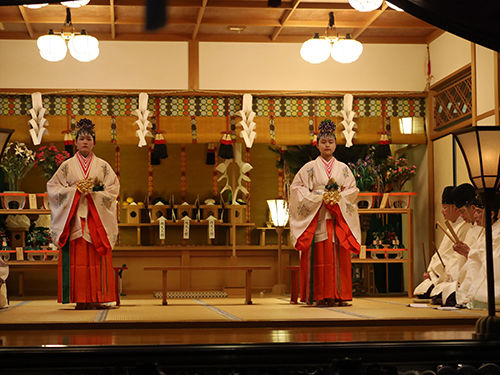
5:00 PM Oshukusho Festival
Following the Onyudate ceremony at 4:30 pm, the Oyukusho Festival is held to pray for the safe execution of the Onmatsuri. The Oyukusho is a place where the Yamato priests, who are in charge of the Yabusame (horseback archery) in the Onmatsuri, purify themselves before serving in the ritual.
The Oyadosho is packed with the costumes and ritual implements used in the Onmatsuri O-Watarishi Ceremony. The "Nodachi no Tachi", which is said to be a travelling weapon, and the bamboo stalks of the Umanagaji are particularly eye-catching. Rare ornaments called "kengashi" (offering sweets), "shimadai" (island table), and “sakazukidai (cup stand) are offered in front of the altar. “Kakemono” is a type of offering that includes pheasants, salmon, and sea bream, etc., which were originally donated by the lords of Yamato and now by local worshippers, and are hung in the front yard as offerings. On this day, the Oyadosho is bustling with activity as the local shopping district serves up the On-matsuri's signature dish, "Noppe Soup."
December 16th
2:00 p.m. Yamato Samurai Yoimiyamoude (Yamato Samurai Yoimiyamoude)
The Yamato samurai, accompanied by young boys performing yabusame, travel from the Oyadosho to Wakamiya Shrine, offering sacred wands and offering prayers. They also visit Omiya and Tamukeyama Hachiman Shrine.
3:00 p.m. Dengakuza Yoimiya Pilgrimage
The Dengaku troupe visits Omiya and Wakamiya shrines and offers dengaku.
3:00 p.m. Dengakuza Yoimiya Pilgrimage
The Dengaku troupe visits Omiya and Wakamiya shrines and offers dengaku.
4 p.m. Yoimiya Festival (Yoimiyasai)
The Yoimiya Festival is a Shinto ritual to pray for the safe execution of the festival at Omiya and Wakamiya, and ancient offerings called "no shinsen" are made before the Wakamiya shrine. Afterwards, the main shrine of Wakamiya is covered with white (purifying) cloth.
December 17th
12 a.m.(From Wakamiya Main Hall to Otabisho) Senkou no Gi (Ceremony of Enthronement)
This is the ceremony to transfer Wakamiya-sama from the main hall to the temporary shrine, and has been considered a mystical ritual since ancient times. Since it is held in complete darkness, all lights on the path to the shrine are turned off, and attendees are not allowed to take photographs or even use flashlights. The process of transferring the divine spirit is carried out using an extremely ancient and unique method. The path leading to the shrine where Wakamiya-sama walks through the darkness is purified with two large torches at the front, and the priests surround the divine spirit with layers of sakaki branches, all of whom join together in a continuous chant of "Wo, wo" as the spirit is transferred. Musicians accompany the procession, playing musical instruments.
1:00 AM - 2:00 AM (at the Otabisho) Akatsuki Festival
Once the ceremony of the enshrinement is successfully carried out, a bell is erected in front of the temporary palace to mark the arrival of Wakamiya-sama, and a bell is raised in the center of the palace, casting a faint light. Fires are lit in the garden around the stage of the temporary palace, and the Dawn Festival is solemnly carried out.
Items from the sea, rivers, mountains, and fields are offered before the altar, and the Omiya family, the former chief priest, presents an ancient offering called " no ." Next, a sacred wand is offered, and after the chief priest recites a prayer, a traditional kagura dance is performed. The pure sounds of singing, drums, and flutes echo quietly throughout Kasugano.

9:00 AM (At Kasuga Taisha Omiya (Main Shrine), Otabisho) Main Shrine Festival and Wakamiya Orusugoto
This ancient ritual, in which offerings are made to the Wakamiya Shrine from the Omiya (main shrine) and the Otabisho, has been revived in recent years.
12:00 p.m. (Departure from Nara Prefectural Office Square) Handover Ceremony
12:50 p.m.~ (at the site of the Great South Gate of Kofuku-ji Temple) Namdaemun Gate Name Ceremony
Since ancient times, the O-Watari Ceremony has been called Shimo-Watari, starting from Kofuku-ji Temple up to the first torii gate, and Kami-Watari, from the first torii gate to the Otabisho shrine. The central event of Shimo-Watari is the Kona ceremony. The central event of the Shimo-Watari is the Kona ceremony. This ceremony shows respect to Kofuku-ji Temple, which has the right to host the festival, and also checks whether there are any omissions in the O-Watari ceremony. It is currently held at the former site of the South Gate, with the attendance of the Kofuku-ji monks.
In particular, the roles that came from the Kofuku-ji Temple would use their names and horse racing would be called “Hoin Onuma no Soro”, and horse races would be called “monk rank monk”. These are all performed by the Daidoji. The Yamato priest also reads out loud the name of the deity that the Oshi actor is carrying in his pocket, making this a very traditional event. There is also a history of people being forced to take the piece back and start over if there was a misreading or an act of impoliteness.
1:00 p.m. ~ (At the Kagemuko Pine Tree inside the First Torii Gate) Matsunoshitashiki Ceremony
Inside the first torii gate, on the platform on the south side, there is a pine tree called “Yogo no Matsu”. This pine tree is said to be the same pine tree painted on the mirror panel of the Noh stage. Legend has it that Kasuga Daimyojin, dressed as an old man, performed the Banzaigaku dance in front of it. In the procession that passes through here, each performs a traditional performing art or a designated dance. In the past, two people, selected from the academic monks of Kofuku-ji Temple and the Nanto Magistrate who had jurisdiction over Nara, supervised this ceremony. This important role has been revived in recent years.
1:00 p.m.~ (From Ichinotorii-Maidebashi Bridge to Otabisho-mae Shobu Sakaki)
Horse racing
2:30 p.m.~ (From the first torii gate to the area around Umadebashi Bridge)
Children's Yabusame
2:30 p.m. (At the Otabisho)
Otabisho Festival
11:00 p.m.~ (From the Otabisho to Wakamiya Main Hall) Return Ceremony
This is a Shinto ritual in which Wakamiya-sama returns from the temporary shrine to the main shrine, and like the Nogi ceremony, it is held in complete darkness and has been considered mysterious since ancient times. Wakamiya-sama is to return to the main hall before the date changes on the 18th, so as not to be absent from the main hall for two days. At the Kanko-no-gi ceremony, Doraku is played, but the tempo is slightly faster and lighter than that of the Senko-no-gi ceremony.
At the main shrine of Wakamiya Shrine, a priest awaits his return and beats a drum, and the sound of the drum blends subtly with the music of Doraku as Wakamiya is safely enshrined in his original palace. Once the deity is enshrined, lanterns are lit in the main hall, and the traditional Kagura dance is performed in the Kagura hall, bringing the magnificent festival to a close.

December 18th
1 p.m. Dedication Sumo
In the past, it was dedicated on the day of the On-matsuri festival, and the Bugaku dances of the Otabisho Festival, and the Bugaku dances of the Otabisho festival, “Bato Batou” and “Rakuson” were sumo competition dances. Currently, the event is held the day after the Otabisho Festival in a special sumo ring on the south side of the Otabisho, with the cooperation of the Nara Prefecture Sumo Federation, Nara City Athletics Association, and Nara City Sumo Association.
2:00 p.m. Goen Noh (after-party Noh)
On the grass stage of the Otabisho, with the temporary shrine where Wakamiya-sama resided before being returned to the main shrine as a backdrop, the second Noh play and the first Kyogen play are now dedicated. This has been held as a way of giving thanks for the safe execution of the Onmatsuri and as a reward for the hard work of the volunteers.
If you’re in the Nara area and you love traditional processions, be sure to dress warmly and check out the Kasauga Wakamiya Onmatsuri.
LINKS
Image 2 https://yamatoji.nara-kankou.or.jp/01shaji/01jinja/01north_area/kasugataisha/event/y6xxhuj6nl/


uu88sh com mình thử mở lên vì nhớ mấy trang kiểu mini game trước đây hay làm rối mắt, nên ban đầu cũng hơi dè chừng. Lướt một vòng thì thấy họ trình bày gọn, nhìn phát là biết đâu là phần nội dung chính, không phải kéo lên kéo xuống nhiều. Mình không có thời gian ngồi lâu, chỉ tò mò xem có gì dễ dùng không. Có mục PHÁ GẠCH khá rõ ràng, tên nghe đơn giản đúng kiểu mình hay chơi lúc giết thời gian. Vào trong thì phần hướng dẫn điều khiển đặt ngay trên nội dung, ghi thẳng ← → hoặc A D để di chuyển thanh, Space để bắt đầu bắn nên khỏi phải…
Me parece muy interesante la información de este artículo, especialmente porque ayuda a los lectores a conocer mejor los temas relacionados con los sorteos. Para quienes buscan resultados y datos actualizados, loteria nacional puede ser una opción práctica para consultar información de forma sencilla y rápida.
Game rikvip hôm trước mình cũng tò mò bấm vào xem thử cho biết thôi, kiểu lướt nhanh chứ không ngồi tìm hiểu sâu hay chơi gì. Vừa vào là thấy giao diện khá sáng sủa, nhìn không bị rối mắt. Mấy phần thông tin được chia thành các khối riêng nên kéo xuống khá “dễ thở”, không có cảm giác bị dồn chữ liên tục. Mình để ý cái menu đặt ngay chỗ dễ nhìn, bấm qua lại giữa vài mục thấy phản hồi nhanh, không phải load lâu hay phải mò mẫm. Nói chung cảm giác dùng kiểu tiện tay, hợp với ai chỉ muốn xem nhanh nội dung chính. Nhìn tổng thể thì mình thích nhất cách…
Mình hay ưu tiên các bài viết nói về game giải trí theo kiểu tóm tắt, dễ đọc trên điện thoại. Phần nói về trang chủ Sc88 bù link nha được đặt ở giữa nội dung nên mạch bài khá tự nhiên, không bị “đẩy” ngay từ đầu. Bài mô tả nền tảng theo hướng gọn gàng, thao tác nhanh và có nhiều nhóm trò chơi để lựa chọn như slot, mini game, esport, thể thao... Cách viết vừa đủ thông tin để người đọc tự hình dung trải nghiệm.
Someone in a Facebook group I'm part of mentioned planetclicker so I went to check it out. Wasn't expecting much but the interface turned out pretty clean, nothing overwhelming. The upgrade section is displayed clearly, easy to track progress.