


Sapporo Snow Festival: Watch the City Turn Into a Winter Wonderland


The Harbin Ice Festival and the Quebec Winter Carnival are among the most famous winter festivals in the world. But did you know that Japan also hosts one of the largest snow festivals on the planet? Held on Japan’s northern island of Hokkaido, the Sapporo Snow Festival (さっぽろ雪まつり) welcomes over two million visitors from Japan and abroad every year and rivals its famous counterparts in China and Canada in both scale and spectacle.
Mention Hokkaido to almost any Japanese local, and chances are the Sapporo Snow Festival will come up. Held every February for about one week, the festival fills the city with massive snow and ice sculptures, interactive winter activities, food stalls, and live entertainment. The event takes place across three main sites: Odori Park, Susukino Site, and Tsudome Site, each offering a slightly different way to enjoy the festival.
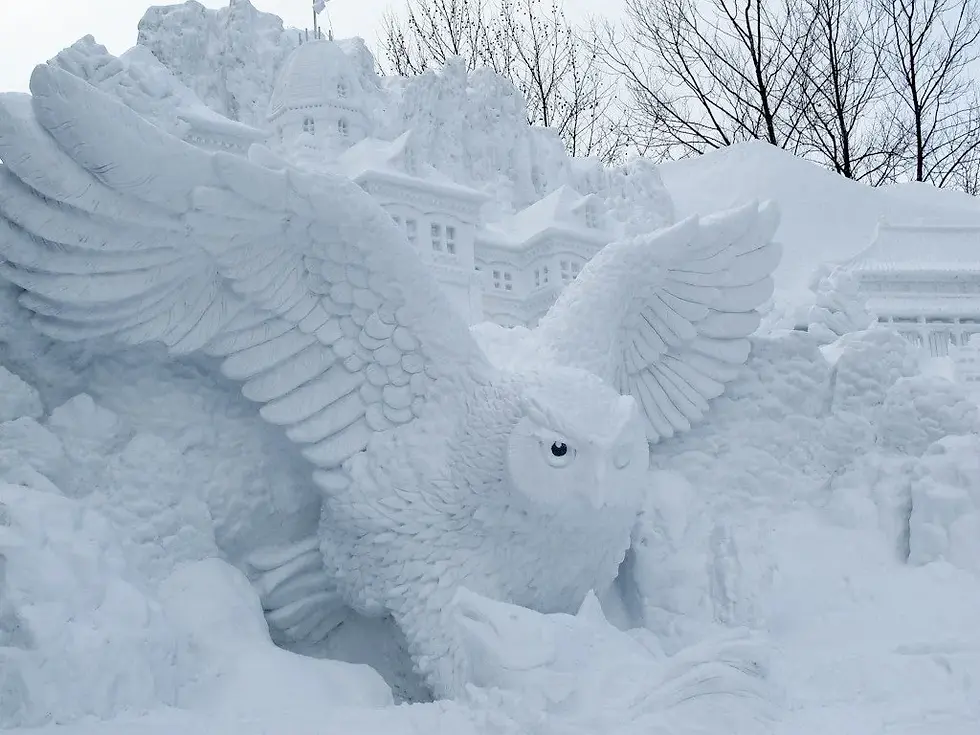
You can freely wander through the snow and ice displays throughout the day at Odori Park and Susukino, while Tsudome Site opens from 10:00. After sunset, the sculptures are illuminated, creating beautiful streaks of light that transform the city into a winter wonderland. Each site also offers its own selection of food and performances, making the experience lively both day and night.

Putting together an event of this scale is no small task. Every year, around 30,000 tons of snow are used to create roughly 200 snow and ice sculptures, many inspired by pop culture and anime. Depending on their size, these works can take anywhere from two weeks to a full month to complete. Artists don’t work alone. Volunteers and members of Japan’s Self-Defense Forces assist with constructing the larger pieces. One of the most memorable examples was the towering Gulliver statue in 1972, which stood an impressive 25 meters tall.

How The Snow Festival Began

The Sapporo Snow Festival may be world-famous today, but its beginnings were surprisingly humble. In the early 1950s, a small group of high school students created just six snow sculptures in Odori Park. To their surprise, the display attracted around 55,000 visitors and quickly gained local attention.
As interest grew, so did the festival itself. By 1955, the Japan Self-Defense Forces stationed in Hokkaido became involved as part of their training exercises. Their participation helped introduce better techniques and allowed for much larger, more elaborate sculptures to be created.

By 1959, the festival had gained nationwide recognition, drawing approximately 2,500 people to help create the sculptures. When Sapporo went on to host the Winter Olympics in 1972, the snow festival reached international fame. Since then, it has continued to grow both culturally and commercially,eventually becoming the iconic winter event we know today.
International Snow Sculpture Contest

Following the Winter Olympics, Sapporo introduced the International Snow Sculpture Contest in 1974. This competition brings together teams from different countries and regions, all challenged to create the best snow sculpture in just five days.
So far, teams from around 37 countries and regions have participated. This year, eight teams will represent Finland, Poland, Austria, Hawaii, Mongolia, Thailand, Singapore, and Indonesia, with two additional teams coming from Sapporo’s sister cities: Portland in the United States and Daejeon in South Korea.
Each team either chooses its own theme or is assigned one by the organization. These sculptures are often viewed differently from those created by local groups, thanks to their distinct styles and longer planning processes. Over the years, the contest has become a core part of the festival, highlighting Sapporo’s dedication to international exchange, creativity, and cultural dialogue.

Recent winners include Mongolia’s “Life” (2025) and “The LEE / Warmth” (2024). Before that, Thailand dominated the competition for three consecutive years with “Let’s Protect the Future of the Earth with Our Own Hands” (2023), “Betta Shine – The Beauty and Strength of Thailand” (2019), and “Thai Fighting Cock Gai Chong” (2018).
Where It All Happens: The Three Sites
The Sapporo Snow Festival takes place simultaneously across three locations: Odori Park, Tsudome Site, and Susukino Site. Each site offers its own unique atmosphere, attractions, and displays. So no matter where you go, there’s always something new to experience.

Odori Park
Located right in the heart of the city, Odori Park serves as the festival’s main site. Stretching approximately 1.5 kilometers from 1-chome to 12-chome, the park is lined with massive snow sculptures reaching up to 15 meters high and 25 meters wide, along with various events and attractions in each district.
This year’s themes by chome (district) include:
1-chome: J:COM Square
Featuring an instax snowboard experience space.
2-chome & 9-chome: Citizens’ Square
Showcasing small snow sculptures created by citizens, along with a popularity contest.
3-chome: Sapporo Smile Square
Includes an ice-skating rink on the east side and a “GX Decarbonized Area” featuring hydrogen energy on the west.
4-chome: STV Square
Featuring a large snow statue of the Hollow Clay Figurine, regarded as a national treasure of Hokkaido.
5-chome: Hokkaido Shimbun Snow Square
Highlighting “Thoroughbreds Galloping to Sapporo,” honoring the JRA Sapporo Racecourse.
6-chome: Snow Art Square
Featuring works by five artists from the Hongo Shin Memorial Sapporo Sculpture Museum, plus medium-sized sculptures from Chiikawa and Kewpie.
7-chome: HBC Square
Showcasing a large sculpture of Hokkaido University’s Furukawa Auditorium.
8-chome: HTB Snow Square
Featuring Tsuruga Castle of the Aizu-Wakamatsu clan, assisted by the Japan Ground Self-Defense Force.
10-chome: UHB Family Land
Featuring a large sculpture inspired by the upcoming film Star Wars: The Mandalorian and Grogu.
11-chome: International Square
Hosting the 50th International Snow Sculpture Contest.
For a different view of the festival, head to the Sapporo TV Tower on the east side of the park. The observation deck offers stunning views of Odori Park, especially at night when the illuminations begin. Tickets cost around ¥1,500 for a day-and-night pass or ¥1,000 for a single visit. During the festival, operating hours are extended, so it’s worth checking the schedule in advance.
Odori Park is open at all hours, though illuminations end at 10:00 pm. Admission is free, except for certain attractions such as the skating rink at 3-chome.

Tsudome Site
Located slightly outside the city center, Tsudome Site is especially popular with families. The site is divided into indoor and outdoor areas. Indoors, visitors can relax at rest areas, enjoy gourmet food stalls, watch performances on the event stage, or let children play in the dedicated playground.
Outside, there’s plenty of winter fun to be had, including:
Three snow slides of varying heights
Snow rafting
A snow maze
Snowman-making areas

Tsudome Site operates from 10:00 am to 4:00 pm and may close early if it becomes crowded. Outdoor activities require a separate fee.

Susukino Site
Named after Sapporo’s largest entertainment district, the Susukino Site offers a completely different atmosphere. Around 60 ice sculptures line the streets, glowing under colorful neon lights that mirror the district’s lively nightlife.
Susukino is also home to the Ice Sculpture Contest, where you can watch artists carve their creations on the spot. This year’s theme, “Enjoying and Touching Ice,” invites visitors to experience the sculptures up close. One crowd favorite is the fish ice sculpture, with some even containing live fish inside.
If you need a break from the cold, you can warm up at the ice bar nearby. Illuminations here run until 11:00 pm, a little later than those at Odori Park.
How To Get There
From JR Sapporo Station, here’s how to reach each site:
Odori Park
About a 10-minute walk
Subway to Odori Station
Susukino Site
Subway on the Namboku Line to Susukino Station
Tsudome Site
Subway on the Toho Line to Sakaemachi Station, followed by a 15-minute walk
Shuttle buses run from Sakaemachi Station, as well as every 5 to 10 minutes from Odori Site and JR Sapporo Station.
No parking is available
Picture Sources:
https://voyapon.s3.amazonaws.com/wp-content/uploads/2025/01/30035413/SapporoSnowFestival00.jpg
https://notesofnomads.com/wp-content/uploads/2012/01/Yuki-Matsuri-Owl.jpg.webp
https://img.activityjapan.com/wi/sapporo-yukimatsuri_thumb.jpg
https://www.japantimes.co.jp/uploads/imported_images/uploads/2022/01/np_file_136001.jpeg
https://www.sapporo.travel/en/bunkazaisanpo/sapporoolympicstory/
Made in Canva with the following pictures
https://www.visit-hokkaido.jp/lsc/upfile/article/0000/0178/178_1_l.jpg
https://www.sapporo.travel/cms/wp-content/uploads/2020/10/tsudome1.jpg
https://www.snowfes.com/common/img/p-sites/map-tsudome01_2026.webp
https://www.snowfes.com/common/img/p-sites/thumb-susukino01.webp
Sources:


コメント