


Sawara Grand Summer Festival

The Sawara Grand Festival is one of Kanto’s big three great float festivals. This breathtaking event is comprised of two festivals: the Sawara Grand Summer Festival, also known as the Yasaka Shrine Gion Festival (Sawara), and the Sawara Grand Autumn Festival, also known as the Suwa Shrine Autumn Festival. Together, these festivals have been designated as a National Important Intangible Folk Cultural Property by the Japanese government since 2004. With a history spanning more than 300 years, what makes the Sawara Grand Festival so special? Let’s find that answer together.

Gion but not Kyoto’s Gion
Sawara Town is located in Katori City, Chiba Prefecture, and it is home to Yasaka Shrine, which hosts the Gion festival, not to be confused with Kyoto’s Yasaka Shrine or Gion Festival. While many prefectures have their own Gion festivals today, the first Gion festival was held in Kyoto in 869 (National Diet Library, Japan). Though we call it a festival today, the procession was anything but festive. When an epidemic struck the nation, the Gion goryō-e ceremony was held as a purification ritual.
To ward off evil spirits and appease the deities, portal shrines were carried throughout the city as a way to purify the lands and the people. Gion goryō-e was later changed to Gion-e, which is just the historical name for Gion Matsuri, the Gion Festival. From 869 until 970, Gion-e was only performed when there was an epidemic. Since then, they have been held annually with beautiful processions, floats, and portable shrines that still carry the desire to ward off sickness and bad luck.

“Historical documents show that the Gozu Tenno Shrine, the predecessor of Yasaka Shrine, was already enshrined in the Sawara Yokaichiba area in the 14th century. It is not certain when the Gion Festival itself began, but by Genroku 15 (1702), the Hamashita ritual was held on the 10th day of the 6th month of the lunar calendar, and the Gion ritual was held on the 12th day of the 6th month” (Katori City Hall). What started as a strict procession that allowed only shrine attendants to assist with the portable shrines became a community effort, with villagers helping to carry them. The procession would pass through neighborhoods and finally make its return to the shrine. Finally, in 1714, the tradition of floats joining the procession began.
According to the Katori Tourism Association, the festivals started as a way to reward the working class for their diligent development of the town, which became one of the 86 official riverports. “Currently, large dolls are the main decorations on the parade platforms, but originally, the parishioners made them by hand each year for the floats to be used. Traces of this past can still be seen in the straw hawk of the Niijuku district and the straw carp of the Yokaichiba district.
Later, in the late Edo period, the production of these dolls was commissioned from doll makers in Edo. What started as a simple festival to reward the workers of Sawara, whose economic power had increased, gradually became more elaborate in the mid-Edo period, with each neighborhood competing and eventually growing to the point where each neighborhood built its own float. There is a record that eight floats appeared at the Shinjuku festival in 1721, and the origin of the Sawara float festival is currently considered to be this 1721" (Katori Tourism Association).
Grand Summer Festival (Yasaka Gion Festival)
Unlike the autumn festival, which has 14, the Grand Summer Festival only has 10 floats, but the lack in number doesn’t take away from the beauty and craftsmanship poured into them. Each float comes from a historic neighborhood in Honjuku that has a longstanding history of participating in the festival. By the late Edo period, larger dolls, closer to what we see today, were made by Edo craftsmen and began to appear in the festival (Katori Tourism Association).
The dolls sat on their own float, and they continued to grow in size year after year. In the early years of the festival, it wasn’t uncommon to see processions with chrysanthemums, carp climbing waterfalls, and animals displayed atop a float. However, after the Meiji Restoration (1868), the dolls of imperial ancestors such as Emperor Jimmu and Emperor Nintoku became commonplace.
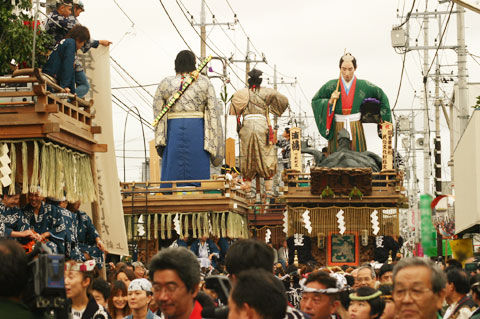
In addition to the grandeur of the dolls, the carvings on the carts and floats themselves are something you won’t want to miss. Each float tells a different story, and some floats carry original carvings from masters long passed. Another piece of history that is unique to this festival is the music of Sawara Bayashi.

Sawara Bayashi (Sawara Hayashi)
This National Important Intangible Folk Cultural Property is a unique music style that is mainly comprised of emotional melodies that are hard to forget. An important part of the festival, the musicians, the Shimoza, ride on the floats and add to the excitement of the day. The Shimoza are “…similar to those in Kabuki theater, and consist of around 15 people: 5-6 flute players, 1 large drum player, 4-5 small drum players, 1 large drum player, 1 small drum player, and 1 cymbal player.
The music is divided into categories such as "Yakumono," "Danmono," and "Hashimono," and is performed according to the location and situation. The floats are lined up in a predetermined order, the "Toshi Sangiri" is played, and then the floats begin to move to the lively "Baka Bayashi." This is the piece known as "Yakumono." It is also an opportunity to showcase the unique characteristics and skills of the Shimoza group on each float” (Katori Tourism Association).

2026 Sawara Grand Summer Festival
This year’s festival will start on July 10th and end on July 12th from 10 a.m. to 10 p.m. Below are the festival details from the official website.

To make things easier for attendees, the festival committee has created a digital map of the festival. This map provides information about the location of your floats. It can be accessed here. If you touch the town icon, you can see information about the floats. It also displays rest areas.
Whether it’s the music or the floats that appeal to you, the Sawara Grand Summer Festival is one that is sure to transport you through time and leave a lasting impression. 🏮
Sawara Grand Summer Festival
LINKS


コメント