


Tea Ceremony: The way of tea

Introduction
In the past few years, matcha (powdered green tea) has grown in popularity as a trendy flavor. It is present in drinks, desserts, baked goods, and many more things all around the globe. While the focus of matcha in pop culture is flavor, in a traditional Japanese tea ceremony, the focus is on the process of preparing and drinking matcha. Everything from the setting of the room, the arrangements of elements like flowers or scrolls, the utensils to prepare matcha, and the proper procedure are all important aspects in a tea ceremony.

What is the Japanese Tea Ceremony?
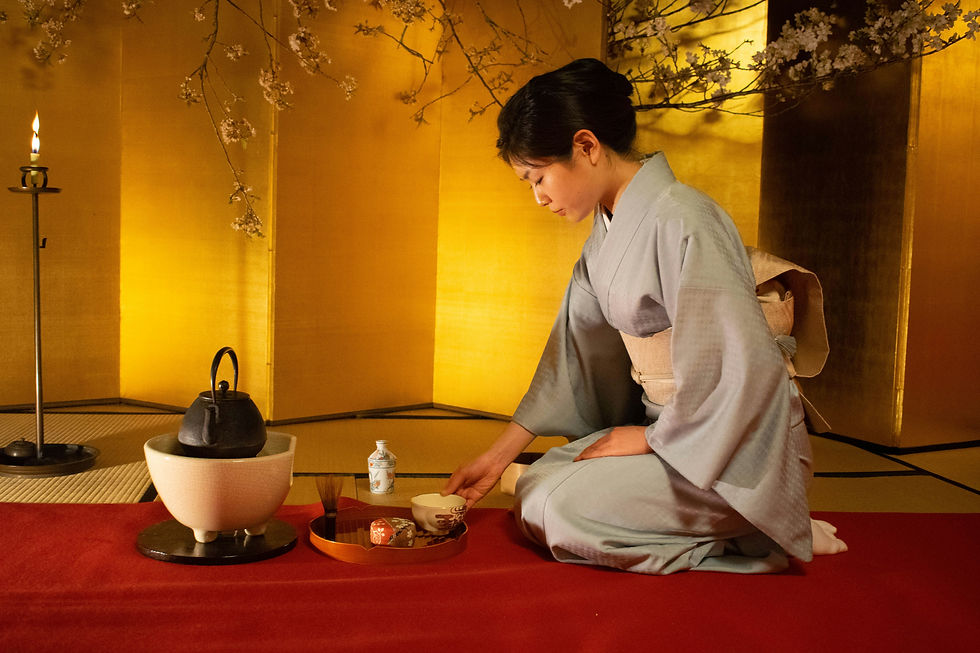
The Japanese Tea Ceremony is a ritualistic approach to preparing and drinking matcha, which is the powdered form of green tea. It is a practice that encourages mindfulness, meditation, and gratitude. It is also a way to express hospitality from the host to guests. In Japanese, tea ceremonies are called Chado/Sado (茶道), which translates to “way of the tea”. You might also hear people refer to it as Chanoyu (茶の湯), which is an older term referring to the practice. Otemae (お点前) refers to the sequence of steps and gestures used in tea ceremonies.
Tea ceremonies are often held in specially constructed spaces called Chashitsu (茶室), which can be translated to tea houses. These are usually tatami rooms, standardly 4.5 tatami mats big, but can be smaller or larger. Inside these tea houses, there is always an alcove for hanging scrolls, as well as flower arrangement decorations.
History
Before the introduction of tea to Japan, in China, tea had been cultivated and used for thousands of years for medicinal, religious, and recreational purposes. Tea was introduced to Japan in the 8th century, when a Buddhist monk named Eichu returned from China and prepared sencha (tea leaves steeped in hot water) for Emperor Saga (Japan National Tourism Organization, n.d.).
Powdered green tea would later be introduced to Japan in the 12th century, when a Buddhist monk named Eisai, who created the methods of grinding tea leaves into powder and then pouring hot water over it to make tea, became the basis of preparing matcha in tea ceremonies today (History of the Japanese Tea Ceremony, n.d.).
In the 13th century, tea ceremonies spread among the Kamakura noble class. These tea ceremonies were not the quiet and simple practices we know today, but rather extravagant tasting parties called Toucha (闘茶), in which participants competed with each other in identifying different types of tea for prizes. These parties also included gambling, consumption of alcohol, and displays of ornately imported tea-making utensils and other products from China (History of the Japanese Tea Ceremony, n.d.).
During the Muromachi period (1333-1573) in Japan, tea ceremonies became more widespread throughout Japanese society. It is during this time period that Zen Buddhists would take the practice and apply Zen philosophies and principles into it, shaping it into the tea ceremony we know today. They turned the lavish tea parties into an occasion that focuses on mindfulness and meditation (Japan Guide, 2025).
The most important figure during this period was Sen no Rikyu (1522 - 1591), often cited as the forefather of the tea ceremony. He was born in Sakai, which is now located in Osaka Prefecture, into a wealthy merchant family. He was the tea master to prominent leaders at the time, namely Oda Nobunaga and Toyotomi Hideyoshi. He refined the minimalist and rustic aesthetics of the decoration of tea houses, tea-making utensils, and the practice itself into Wabi-cha (Japambience, 2025).

Philosophy
Tea ceremonies in Japan are a practice rooted in Zen Buddhism, and owes its history to Zen Buddhist monks who first introduced it to Japan, and then later perfected the craft into the practice that people know today.
The two most important concepts in tea ceremonies are Ichigo Ichie (一期一会) and Wa-Kei-Sei-Jaku (和敬清寂). Ichigo Ichie is a concept that roughly translates to “this experience will never happen again”. It means that each tea ceremony is shaped by the unique and specific time, place, and experience of the hosts and guests, and it will never occur again the same way. It reminds both the hosts and guests to be fully present during the experience.
Wa-kei-sei-jaku translates to harmony, respect, purity, and tranquility - principles set by Sen no Rikyu, who refined the style of tea ceremony called Wabi-cha. Wabi-cha is based on the concept of Wabi-sabi, a philosophy that embraces the transient, rustic and imperfect nature of life.
Different schools of tea ceremonies
In the tea ceremony world, there are three main schools: Omotesenke, Urasenke, and Mushanokoji-senke, which were established by the sons of Genpaku Soutan (1578 - 1658), Sen no Rikyu’s grandson. Each school is led by the descendants of the respective school’s founder, and has its own protocols on the methods of preparation, etiquette, and the decoration of tea houses.
All three schools are rooted in the same philosophical foundation of Wabi-cha. At the head of each school is an Iemoto (家元), a “grandmaster” that pass on the practice to the followers of each school, and often is a role inherited through generations.
Urasenke
The Urasenke school was established by the fourth son of Genpaku Soutan, and the current grandmaster is the 16th generation: Sen Shoshitsu XVI. This school is the easiest entry point for English speakers, as they have their resources available in both Japanese and English, and it has established a presence all over the world, including chapters in North and South America, Europe, Africa, and so on. Their grandmasters have had tea ceremonies with many major world leaders, and make international outreach a part of their mission.
Omotesenke
The Omotesenke school was established by Soutan’s third son, Koushin Sousa (1613 - 1672). This school focuses heavily on the intimate relationship between the grandmaster and disciple, which can last decades. It is also a more formal and rigorous school of tea compared to Urasenke, with precise and detailed protocols regarding utensils, decoration, and procedure. Omotesenke has a few branches internationally in the United States and France, as well as cultural classrooms to spread the tea ceremony to people in Japan.
Mushanokoji-senke
Ichio Soshu was the founder of Mushakoji-senke, and one of Soutan’s sons. The current grandmaster is the 15th generation, Zuiensai So’oku. This school is centered on the Kankyuan tea house in Kyoto. This is a smaller school compared to Uransenke and Omotesenke that aims to balance the elements of the traditional tea ceremony with modern times to further spread the practice and message of tea ceremonies.

Procedure
Tea masters often wear a formal kimono, and guests are expected to wear a kimono for formal ceremonies as well. In more casual sessions, guests are welcomed to wear casual clothes. Guests sit and wait in a waiting room before being invited in by the host. Before entering the tea house, removing shoes is required. After entering the tea house, guests and the host sit in a seiza position, which is a kneeling position, and bow to each other. Wagashi (和菓子), Japanese sweets, are served to guests and are supposed to be consumed before tea is served. While guests are enjoying the sweets, the tea is prepared by the host.
The host cleans the serving bowls and utensils with a fabric cloth before making the tea. Then, a tea scoop - Chashaku (茶杓) - is used to scoop matcha out of the tea container - Natsume (棗) - onto the serving tea bowls, called Chawan (茶碗). Hot water is then added and whisked together by the tea whisk - Chasen (茶筅). After preparing the tea, the host serves the bowls to the guests.
The guests are supposed to hold the bowl with their left hand and turn the bowl so that the front of the bowl is facing away from them before they start enjoying the tea. After enjoying the tea, guests are expected to compliment the wares used, as well as the decorations such as the scrolls and flowers in the tea houses. The ceremony ends once the host puts the tea utensils in their original place.

Experience
Today, many tourists who come to Japan have a variety of options to experience tea ceremonies. Many teahouses across Japan host experiences for visitors and tourists, often in both English and Japanese. First experiences are usually in the shorter ceremony form, served with wagashi. Guests are welcome to wear their own kimono, but some places even offer kimonos for guests on-site for their experiences. Most experiences include a lecture on the history, proper procedures, and practices of the tea ceremony along with the serving of tea and sweets.
I had the opportunity to participate in a tea ceremony at Chikusuian Tea House. This tea house offers tea ceremony experiences and classes in the Kamakura and Harajuku areas, in both English and Japanese. I did a 60-minute tea ceremony session at their Kamakura teahouse tucked away in a quiet residential neighborhood. The ceremony included wagashi, a bowl of matcha prepared by a tea master, a bowl of matcha we prepared ourselves, and a Q&A session with the tea master.
Although she did not speak English, there was an assistant who translated for us, which we very much appreciated. It was a very special experience and very informative. I had felt a bit nervous before the experience, as I assumed tea ceremonies would be more formal, but after the session, I felt more relieved and gained a lot of appreciation for the intricacies of the tea ceremony, as well as gratitude for the hospitality that was shown to me.

Closing remarks
The tea ceremony is one of Japan’s many traditional practices that emphasizes patience and meticulousness, and also one that brings out the beauty of simplicity. The current matcha trend around the world has brought many people to learn more about matcha and Japan’s tea ceremony.
During my experience, I asked the tea master how she felt about it, and she expressed that she is very happy that people are getting curious about tea ceremonies and Japanese culture, and she hopes that many more people in the world get a chance to learn more about it. It is an experience definitely worth trying if you are visiting Japan and interested in Japanese culture, history, or just want to have a taste of the Japanese way of hospitality.
Image sources
Sources
Japanese Tea Ceremony | Guide | Japan National Tourism Organization
A Beginner’s Guide to Japanese Tea Ceremony: Chanoyu, Schools, and Craft | Kogei Japonica
Sen no Rikyu: The Man Who Redefined Japanese Aesthetics Through Tea
Chikusuian: Tea Ceremony Experiences & Rental Tea Rooms in Harajuku, Tokyo & Kamakura, Kanagawa


コメント