


The Night Demons Run for Blessings: Nara’s Oni Hashiri 陀々堂の鬼走り

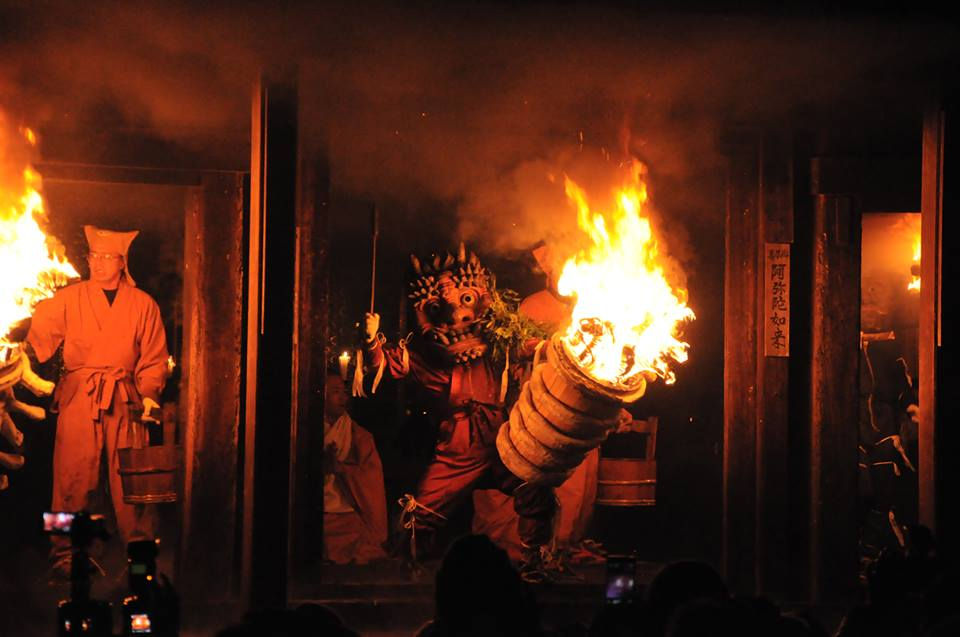
Every year on January 14th, the grounds of Nenbutsu-ji Temple (念仏寺) in Nara Prefecture come alive with fire, sound, and ancient ritual during Oni Hashiri. Directly translated as “demon run,” the demons of Oni Hashiri represent ancestral spirits who return to the human world at the start of the year. Not to cause harm, but to bring good luck and protection to their descendants. This goes against the common notion that demons are evil.
This traditional festival has been performed for over 500 years and is held at the temple’s Dada Hall. In 1995, Oni Hashiri was designated an Important Intangible Folk Cultural Property, recognizing its deep historical and cultural significance.
What happens during Oni Hashiri?
The festival takes place twice a day: once during the daytime and again at night.
The daytime ritual begins with monks chanting sutras, filling the hall with rhythmic echoes at 1:00 pm. By 4:00 pm, a demon run is performed without fire, followed by the throwing of rice cakes at 4:30 pm, a joyful moment for visitors.
From 7:00 to 7:30 pm, the second half of the festival begins, with closing ceremonies held both inside the hall and throughout the temple grounds. By 9:00 pm, the crowd gathers in quiet anticipation for the main demon run. Monks enter the center of the grounds carrying small welcoming torches, signaling the beginning of the night’s most powerful ritual. A bell rings through the cold air, officially setting the ceremony in motion.

Fast, rhythmic chanting rises, joined by the sharp clatter of wooden sticks. As the intensity builds, the Katte performs a fire-prevention ritual called “Hibuse,” praying for safety before the flames grow stronger. The Katen then appears with a burning torch on his shoulder, moving with deliberate control. Tracing the kanji for water in the air, he prays for balance between fire and protection, before slashing the flame downward through the darkness in a gesture reminiscent of Fudō Myō-ō, the fierce guardian deity. Then the Kawase, representing the water deity Suiten, follows by sprinkling water with a bamboo pole to put out any fallen sparks. When the fire gods’ rituals end, the hall suddenly falls silent, building tension for what comes next.
A large torch is prepared behind the altar, and the air begins to thicken with smoke from burning cypress leaves. At the signal to light the torches, the monks move together. The first torch is placed on an assistant’s (suke) shoulder, and he runs toward the northern doorway, where the red demon waits, axe in hand.

Suddenly, conch shells roar and drums thunder. The dark hall is washed in red firelight as the red demon receives the torch, holds it up in the air, and steps forward, sparks flying. The blue demon soon follows with the second torch, and moments later, the brown demon appears carrying three. With all three demons present, the hall becomes a sea of fire, flames reaching toward the ceiling as the ritual reaches its peak.
At last, the first torch is lifted again and carried behind the altar, exiting through the right doorway. The demons circle the hall three times to complete the purification before moving out into the temple grounds. A final bow is made at the Suiten well, restoring balance between fire and water and bringing the Oni Hashiri ceremony to a close.
The entire festival is free of charge and draws worshippers even in the bitter winter cold. Oni Hashiri is also rich in folk beliefs. The way the torches burn is said to foretell the year’s rice harvest. Certain ritual actions are believed to relieve shoulder stiffness, while cords tied to the demons are thought to protect against misfortune throughout the year.
Getting There
Visitors can reach Nenbutsu-ji Temple from JR Yamato-Futami Station on the JR Wakayama Line. From the station, it is about a 30–35 minute walk, a 10-minute drive, or a 20-minute shuttle ride from the Ueno Park parking lot. Those attending the evening ritual should be mindful of the last train, which departs around 10:00 pm.
Blending fire, faith, and folklore, Oni Hashiri remains a powerful expression of tradition where demons do not curse, but instead protect, bless, and welcome the new year.
Picture Sources:
Sources:


コメント