


What is Ikebana? An Outsider’s Experience


Ikebana, a word often translated as “bringing life to flowers”, is a centuries-old art form of flower arrangement deeply associated with traditional Japanese culture. Its sacred origins, storied history, and varied methods by which it is practiced in the present day all contribute to the fascination that I have felt in researching this post, and I hope that this introductory post encourages readers into further curiosity and research on their own.
Origins and Evolution
What is Ikebana?

While flowers have been offered at Buddhist temples in Japan since the introduction of the religion in the 6th century, and there may also be precedent in the indigenous Shinto worship of natural flora and fauna, ikebana as an organized art form first properly emerged in the 15th century. A written record from 1462 mentions that a priest named Senkei Ikenobo at the Rokkaku-do temple in Kyoto created a flower arrangement unlike anything seen before, which was widely celebrated by the people of the city. This moment is considered the earliest historical record of ikebana. The practice must have evolved quickly, as a variety of different styles were visually depicted in a late 1400s manuscript (seen in Image 2).

Successive priests at the same temple, who were also known by the Ikenobo name, continued to develop their flower arrangement art forms over the 16th and 17th centuries, particularly a style known as “rikka” that aimed to replicate the beauty of natural landscapes. Some powerful nobles and warriors commissioned very large works (one example being depicted above) to display on their properties. The prestige of the art form grew, and at one point the imperial family regularly hosted gatherings centered around rikka. The line of Ikenobo priests developed into an organized school of the same name (which still exists today!) to teach styles of flower arrangements, with students of the art form coming from across all of Japan and even from the then-independent Ryukyu Kingdom (the area now known as Okinawa Prefecture).
One rikka arrangement commissioned in 1692 to celebrate the restoration of the Great Buddha at Todaiji Temple reached as high as 9 meters (30 feet). While these extravagant works continued, over the course of the 18th century a smaller and more simplified style known as “shoka” also developed, whose increased practicality led to an explosion in the number of students seeking to study flower arranging (notably, including women for the first time). Different artists started to diversify their art forms into a variety of distinct styles, a process which has continued to the present day.
To highlight the particular school of ikebana that I personally experienced, we will focus on the early 20th century. Sofu Teshigahara, who had learned ikebana from his father and became a talented practitioner from childhood, questioned the rigidity of traditional ikebana and sought to enable more individual creativity and originality for practitioners. In 1927, he founded the Sogetsu School of Ikebana to put free-form ikebana into practice, and his work was quickly praised by art critics. He spread his principles by broadcasting ikebana lessons over the radio, and by extensively exhibiting his art forms both in Japan and abroad.
Rules and Practices

The specific frameworks that guide the arranging of flowers vary by school and style of ikebana, but a few core principles are generally respected. Three main branches are attached to a common base, with the longest and most vertical branch “Shin” representing heaven, and two shorter, angled branches representing humanity and the Earth. The branches are deliberately asymmetrical, and while a few even smaller branches may be added, negative space between the main branches should be deliberately maintained.
These deliberate gaps serve to show off the natural forms and imperfections of the flowers and branches, which is considered reflective of beauty and harmony in the Japanese tradition, and evokes the concepts of balance and minimalism from Zen Buddhist philosophy. This aspect of ikebana starkly contrasts with Western flower bouquets, where flowers are typically symmetrically arranged and densely packed to fill all gaps, and beauty derives from a highly ordered and ‘perfected’ appearance. I think that reflecting on the cultural differences in matters like this is one of the most valuable parts of traveling and exploring new experiences, as it shows that many concepts we might think of as innate and universal are, in fact, culturally variable and reflect the diversity of humanity.
My Personal Experience

To add a personal flair to this blog post, I sought to experience ikebana firsthand and give my own thoughts on the art form. I signed up for a class at Sogetsu Kaikan, the headquarters of the Sogetsu School, in the Akasaka area of central Tokyo. I was allowed to choose my own flowers and was guided through cutting and arranging them in a manner consistent with the principles of ikebana. While Sogetsu is known for its free-form philosophy, the beginner class that I took seemed to be fully in line with traditional principles, using a guide sheet nearly identical to that in Image 4 (though they used a different name “Hikae” for the shortest branch, which I don’t know the meaning of).
I was guided through the process of cutting and arranging my chosen three branches into an arrangement following the formula, after which I was allowed to take apart and reassemble my arrangement without referring to the instructors or written materials. After a round of critique, an instructor then guided me through reassembling the arrangement in accordance with their expertise, resulting in the arrangement depicted in Image 5. I included a few smaller branches, but still clearly showcased the three main branches with negative space in between.
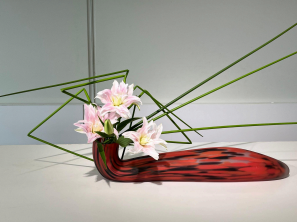
Separately from my beginner work, the expert lead instructor Isono Gaho demonstrated some more advanced and modern techniques used by the Sogetsu School, such as implanting metal wires inside plant stalks to enable them to be bent sharply without losing structural integrity. This method was used to construct the arrangement depicted in Image 6, which is meant to draw attention to the plethora of perfectly straight lines and the sharp angles between them. Using these innovative methods exemplifies the Sogetsu School’s philosophy of modernity and free-form construction by creating this unique and partly unnatural art form.
Final Thoughts
Through this experience, I found ikebana to be a beautiful art form that is also deeply reflective of Japanese philosophies and culture. As an American, I was drawn to intern in Japan partly because I wanted to experience how these philosophies and
traditions reflected on modern life. This art form, particularly the Sogetsu School, provides a microcosm of how Japan is known to blend tradition and modernity, and I am grateful that my internship provided the opportunity to experience it. Given that they coached me into following the traditional formula, I think that the Sogetsu School prefers for their more advanced techniques to be limited to people more experienced in the art, who are familiar with the underlying philosophy and know how to appreciate and enhance it.
Nevertheless, getting to watch the instructor perform such advanced techniques was a worthwhile part of the experience, alongside getting to practice the art’s traditional form myself. I would like to encourage visitors and foreign residents in Japan to give experiences like this a try if they want to actively participate in experiencing the country and its culture. The class I took was highly accessible, and I think almost anyone could enjoy it. Sogetsu Kaikan in particular has a variety of options for both one-time and continuing classes, allowing anyone to experience the art form in accordance with their desires and availability. I hope everyone reading this is inspired to pursue new experiences in their own life.
Sources:
https://www.byaas.com/blogs/home-decor/a-step-by-step-guide-for-ikebana-beginners-r ules-and-techniques
Image Sources:
5-6: Courtesy of the author. Credit to Sogetsu Ikebana and to the class’s instructor, Isono Gaho.


コメント