


Stories Beyond Japan Spotlight Interview with Miki Toyota - #MyGiving Story


With a goal of connecting cultures through communication and community, Tokyo native Miki created Stories Beyond Japan.
We at Giving Tuesday Japan had the exclusive opportunity to interview her about why she started writing, what inspires her to give back, and what her future goals are.
Take a look at the My Giving Story interview between Miki Toyota and our Global Community Team Assistant, April, below!
--------
April: Hi Miki. Thank you so much for taking the time to interview with us! Let's jump right into today's questions. Please introduce yourself.

Miki: Hi, I’m Miki. I was born and raised in Tokyo.
At the core of my work today is helping bridge the gap between Japan and the world.
I help global founders, startups, and international brands communicate, grow, and build trust in the Japanese market.
Through working with teams from Finland and Estonia to Hong Kong, Singapore, and the U.S., I’ve seen how easily cultural differences can affect collaboration. Often, it’s not just language. It’s differences in expectations, communication styles, and how trust is built.
That experience led me into localization, cross-cultural communication, and Japan market strategy.
Outside of my consulting work, I also write, build communities, run events, and support cross-cultural exchange in different ways. You might find me hosting as an MC, interpreting, or bringing people together through volunteer work.
Thank you to Giving Tuesday Japan for having me. I’m really happy to be here.

April: What is “Stories Beyond Japan”?
Miki: Have you heard this Japanese saying?
“The nail that sticks out gets hammered down.”
Growing up, I was a very curious child. I kept asking questions like, “Why does this work this way?”
My father tried to answer every question I had, until eventually he ran out of answers.
But for a long time, I wasn’t proud of that curiosity.
Asking “why” too often wasn’t always encouraged. So I learned to hold back. To observe more than speak. To avoid standing out too much.
Still, that curiosity never really left me.
Over time, I realized it was the very thing that helped me understand people, navigate different perspectives, and move between cultures more naturally.
That eventually shaped both my work and my writing.
I used to be someone who couldn’t even raise her hand in class. Now, that same person chose to stay in Japan, became a community builder, and found direction in her work through curiosity. Stories Beyond Japan started as a place for me to share stories from that perspective.
But after spending time abroad and returning home, I started noticing a gap:
The Japan often discussed online or in international media didn’t always match the Japan I experienced in everyday life. And at times, Japan also misunderstood how it was seen from the outside.
So Stories Beyond Japan is my way of bridging that gap, by sharing small, human moments you don’t usually see in the news.
I love Japan, but I also write honestly about its challenges.
Because loving a place doesn’t mean pretending it’s perfect.
It means caring enough to look at it clearly.
And that’s why I write.

April: You mentioned that you lived and worked abroad. Could you tell us a little about that? How did those experiences influence your writing?
Miki: Have you ever had that feeling when you’re in another country?
For me, living outside Japan didn’t just show me another culture. It made me notice my own.
There were things I never questioned growing up, like how much we adjust ourselves or how careful we are about saying things directly.
Japanese communication can be very nuanced. Sometimes people say one thing and mean something slightly different, and we just understand it. I grew up learning how to read the room.
Then, when I spent some time in the U.S., I realized that wasn’t really the case. If something wasn’t clear, people would ask. I found myself hesitating at first because I was wondering if I should wait for my turn. But I learned quickly to just speak up and join in.
I had similar moments recently working with people from Mexico and Spain. People are more expressive in how they communicate, whether it’s eye contact or just being more open.
At first, those differences can feel confusing on both sides.
You can feel lost in translation without saying a single word.
That’s when I realized that understanding the language doesn’t always mean you understand what’s actually being said.
With AI and translation tools, it’s easy to understand the words, but context can still get lost.
That’s something I think about a lot in my work and writing. I try to help bridge that gap and create more meaningful connections across cultures.
I also met my journalism professor in Ohio. She was the one who introduced me to the fundamentals of storytelling, how to structure a story, how to think about the audience, and how to make something clear and engaging.
That was the first time I learned to write with intention, not just to express something, but to make it understood.
April: What story is nearest to your heart?
Miki: I wrote a piece on LinkedIn about why I chose to stay in Japan.
It came from a question people kept asking me.
I remember at a networking event in Tokyo, someone asked me that.
And I’ve been asked many times since.
By friends who left Japan. By mentors. By people I just met. And it’s a fair question.
Many of my friends have moved to the U.S., Canada, or Europe.
They felt pushed out by low salaries, the gender gap, rigid work culture, and an aging society. And with so much still based on seniority, many felt stuck in their careers.
So I understood why they left.
But at some point, the question changed for me.
It became less about why I stay and more about what I can do if I stay.
I still see the same gaps.
A gap in language. A gap in culture. A gap in how people build trust.
Between the Japanese community and the international community here.
Between people who need support but don’t know how to reach out, and people who want to help but don’t know where to start.
Between global teams entering Japan and Japanese teams trying to go abroad.
I see it in communication.
That’s when my answer became clear.
Leaving won’t fix the problems I was seeing. And as someone who grew up in Japan and has spent time working and connecting with people both inside and outside of it, I feel there’s something I can do to help bridge the gaps I still see.
I wanted to be part of the change happening in Japan.
That’s why I stay.
Why I volunteer. Why I do what I do.
That’s the story I shared.
April: Why is that story so important to you?
Miki: Because it showed me the power of storytelling.
It was just my honest thoughts and my story.
But it reached over 130,000 people, and what mattered most to me was the response.
I received hundreds of messages from people in Japan and outside of Japan.
A startup founder told me it made them rethink their assumptions about Japan’s business culture.
A woman who had just moved to Japan said it made her feel less alone, because she realized she didn’t have to change herself to fit in.
A father shared it with his 10-year-old son, who now says he wants to start a business in Japan!
And some people said it helped them decide whether to stay in Japan or move on, with more confidence.
All of these connections happened because of storytelling.
In that post, I shared my doubts, my thought process, and the moments where things started to shift.
But more importantly, it gave people space to reflect on their own experiences.
That’s when I realized that when you share something honestly, it can reach people in ways you don’t expect.

April: Was there a specific moment that changed your view of the world?
Miki: There was one moment that changed how I see my country and my role in it.
It was at a documentary screening about single mothers in Japan. I was an interpreter for the British and Norwegian ambassadors.
I walked into that room thinking I understood Japan.
I walked out seeing it very differently.
That day, I learned that one in seven children in Japan does not have enough to eat every day.
More than half of single-mother households live in poverty.
Many of these mothers work full-time, yet their struggles often remain invisible.
Because asking for help here can feel like standing out.
And it is not something far away.
It could be happening right in front of me, in everyday life.
A boy sitting next to me on the train, his mother might be struggling to put food on the table. He might not have had breakfast that morning.
Japan is kind to you if you fit into the box society expects.
But if you fall outside of that box, single mothers, hikikomori, even women, life can quietly become much harder.
Around that time, people started asking me,
“Miki, why are you still in Japan?”
“The yen is weak. Why not go abroad?”
“And you are a woman. Wouldn’t it be easier somewhere else?”
Before, I did not always have a clear answer.
But after I saw more closely what many mothers and children go through in my own country, the question changed for me.
It was no longer “Why am I still in Japan?”
But “If I see this, how can I not stay?”
At first, I did not know what to do.
So I did something small.
I organized a discussion event after the screening to continue the conversation. We invited the director, a university professor, and the founder of a single-parent support organization that supports over 13,000 families and more than 20,000 children across Japan.
About 20 people showed up.
During that conversation, the founder said something simple.
“We never have enough volunteers.”
In that moment, I asked myself,
I don’t have a lot of resources. I’m still figuring things out myself.
But can I be a bridge?
Can I connect people who want to help with people who need support?
That question led me to work more closely with the organization.
That December, I brought together international volunteers from different countries.
2024

2025

Not all of the Japanese staff spoke English. They looked nervous, but also curious and open.
So I stayed close.
I translated, joined conversations, and sometimes simply stood between people, helping them understand each other.
One day, in a cold warehouse in Saitama, we were packing Christmas gifts.
A Japanese staff member asked a volunteer from the U.S.,
“Why do you volunteer for children in Japan, even though you are not from here?”
They were surprised.
The volunteer smiled and said,
“Because it is Christmas. I do not want any child to feel sad or lonely.”
At that moment, something felt very clear for me.
People are willing to care, even across cultures. They just need a way to connect. That is the center of what I do now.
From that first day at the documentary screening to today, this experience changed how I think about my role.
I stay because I love Japan.
But loving a place is not pretending it is perfect.
It means you see its problems clearly and choose not to look away.
Leaving would not fix the struggles I started to see.
So I stay.
Not because Japan is perfect.
Because I care. And because I want it to be better.
April: In your article “Do Japanese People Ever Say ‘I Love You’”, you said that your grandfather was the reason you became a storyteller. How did he inspire you?
Miki: My grandfather was a vivid storyteller.
He was born during the war and grew up in postwar Japan as the oldest of five siblings. He would tell me stories about helping raise his younger siblings, carrying his sister on his back, working on the farm, studying hard to build a stable life, and how he met my grandmother through an arranged marriage (they’re the cutest couple!).
His stories took me to a completely different era of Japan.
And it changed how I see and learn things.
In school, history often felt like something you memorize for exams. But growing up with his stories added a lot of depth to how I understand the world.
When I hear numbers or statistics now, I think about the individual lives behind them, because my grandpa taught me everyone has their own story.
Later in his life, he taught mathematics. He enjoyed playing Japanese chess, and he was a very logical person, not the most expressive. I actually never heard him say “I love you.”
But to me, he was a great storyteller.
It made me pay attention not just to what people say, but also to what they don’t say.
That’s a big part of why I want to tell stories about Japan today.
April: How did you choose the name “Stories Beyond Japan”?
Miki: Stories that travel beyond borders.
That was the starting point.
I wanted to share stories from Japan that don’t stay in Japan, but can travel across cultures and be understood in different contexts.
At the same time, I didn’t want to create content about Japan at a surface level.
A lot of content explains Japan in simple ways, but I believe real life is more nuanced than that.
“Beyond” for me means going past what people usually see, beyond stereotypes or headlines, or fixed ideas of how Japan works.
So Stories Beyond Japan is a space where I share stories that show the human side of Japan.
Sharing stories that move across borders and help people see things a little differently.
April: How do you choose your writing topics?
Miki: I usually don’t start with a topic.
I collect moments that stay with me in my notes, like conversations, small reactions, or things I notice in everyday life here in Japan.
I write them down, mostly so I don’t forget how they felt.
It does not have to be very structured or detailed. I keep just enough to remember what happened, who was there, and the feelings involved, so I can come back to it later. And when I do, I ask myself why it stayed with me.
That’s usually where my writing starts.
April: What has been one of the most rewarding aspects of your journey?
Miki: For me, it’s when a story turns into something that moves people to act.
For example, I once shared a story about single mothers in Japan, after working closely with a support organization and seeing their reality more up close.
What I saw was how many mothers are doing everything they can, working full-time, raising children on their own, and still their efforts and struggles are often invisible.
In the post, I also included a way for people to support the initiative. At the time, they were raising funds to deliver food boxes to single-parent families during the summer break, which is often one of the hardest periods.
After sharing it, I saw people not only engage with the story, but take action, sharing it, donating, and supporting the initiative.
Through that, the organization was able to move closer to delivering those food boxes to families across Japan.
What felt meaningful was seeing how a story could create a small circle of support, from awareness to action, and eventually to something tangible.
That’s when I realized the power of storytelling again.
It can actually bring people together and move something forward.


April: What is one of the challenges you faced while starting “Stories Beyond Japan”?
Miki: I wouldn’t call it a challenge, but it was a new experience being more open in public.
I’ve always written in a more professional context, for brands, press releases, or website content.
But Stories Beyond Japan is more personal.
I’m writing from my own life, my family, my childhood, and the people around me.
So I had to get comfortable sharing something more open-ended or emotions I’ve never fully named, without knowing how people would respond.
That part felt unfamiliar at first. But over time, I’ve realized that those are often the stories people connect with the most.
And I’ve been enjoying hearing from readers who tell me it gave them a gentle push to try something they’d been putting off, or it helped them better understand their own experiences, whether in Japan or outside of it.
It’s been interesting to see how those stories travel beyond my own perspective, and it feels like I’m growing through the process, along with the readers.
April: What does charity mean to you?
Miki: Charity, to me, is not always something visible.
I remember seeing that Japan ranked near the bottom in the World Giving Index for “helping a stranger.”
But does it tell the full story?
Part of it might come down to how people define “help.” Some people don’t always label something you naturally do as helping, so they don’t show up in surveys. So help can be quiet. But that doesn’t mean it’s not there.
In Japan, we have this idea of “gaman,” where people are expected to endure things on their own.
Through my work with single-parent families, I’ve seen how many people are trying to manage everything alone, sometimes because of stigma or concern for their children.
But in many cases, they just need someone to notice.
That’s how I started volunteering.
And that’s something we can all do in everyday life.
If someone looks lost, I’ll help them find their way. One time, I helped translate between an Australian traveler and a pharmacist when her child got sick. I remember how relieved she looked after that.
I think it doesn’t always have to be something big.
Sometimes it’s just about not assuming someone else will do it, and deciding to act on what you see in front of you.
Even small things can make a big difference.
So for me, charity is not just about giving. It’s also about noticing and choosing to act, even in small ways.

April: Before we met, had you ever heard of Giving Tuesday?
Miki: Yes, I had come across it when I was in the U.S.
More generally, I remember there being more visible ways to get involved in volunteering. I joined different volunteering activities through student groups, local communities, and NPOs, each focused on different causes.
I packed clothes at a shelter, helped at a food bank, spent time at an animal shelter, and volunteered for a week at Give Kids The World Village in Florida, that’s supported by the Make-A-Wish Foundation.
Coming from Japan, where giving often happens more quietly and isn’t always talked about in the same way, I appreciated how accessible it felt.
So when I came across Giving Tuesday in Japan at your booth, I remember being curious and going straight over to learn more.
Everyone was very welcoming. Jasmine, April, and the team were open and clearly passionate about what they were doing.
Jasmine told me that the team is currently working on different projects, all to help spread the culture of giving in Japan.
I’m usually the one asking the questions, so after this, I’d love to turn the tables and hear more from the Giving Tuesday team about what they’re working on!
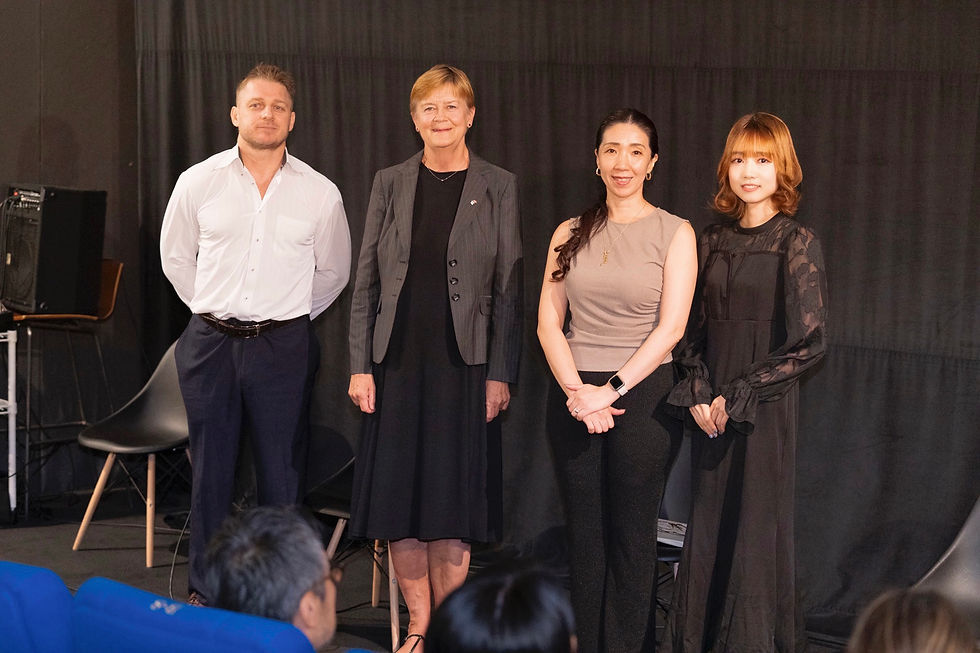
April: What do you hope to achieve with your writing? What is your mission? What are your goals?
Miki: At the core of everything I do is a simple goal. I want to be a bridge.
Between Japan and the world.Between cultures and communities.Between people who deserve to feel seen and understood.
Japan is not perfect. But I love this country, and I want to give back.
I was born and raised in Tokyo, but much of what I write comes from noticing things I didn’t fully see growing up. Through rediscovering Japan, I’ve found a clear role. As someone who has worked across cultures, I want to help bridge the gaps I still see.
I use Stories Beyond Japan and LinkedIn as platforms to celebrate curiosity, connection, and storytelling.
I believe storytelling helps people care.
And care is where understanding begins, and where change starts.
My goal is to contribute to that change, both in Japan and beyond.
April: Do you have anything that you would like to promote?
Miki: Three Cs! Connection, conversation, and community.
Stories & newsletter
I’d love for you to join my newsletter, Stories Beyond Japan, and come say hi on LinkedIn. That’s where I share reflections, updates, and what I’m working on.
For founders building in Japan, I work with international founders and teams to help them communicate and build trust across cultures. If you’re building something here or even just exploring ideas, I’d genuinely love to hear your story.
Volunteering, I’m currently developing community initiatives, including some online programs for single-parent families. I’ve received many kind messages from people all over the world asking how they can support, so I’m putting together a general volunteer interest form to make it easier to stay connected.
In the meantime, the newsletter is the simplest way to stay updated.Everything I’m building in this space is fully volunteer-based. No specific qualifications needed, just your curiosity and willingness to contribute.
One thing I really value from this journey is the people I’ve met.
Many of the opportunities and collaborations in my life today started from a simple connection.
If you’d like to stay in touch, I’d be very happy to connect.
LinkedIn:
Newsletter:
Christmas packing initiative (last year’s reflection):
A reflection on last year’s Christmas volunteer initiative supporting single-parent families across Japan. The project will return again this year, and we’ll be looking for volunteers, so stay tuned through LinkedIn or Substack for updates.
Summer Kids English Camp:
A story connected to Heartful Family’s English camp for children from single-parent households in Japan. Another camp is planned for October 10, 2026, and we’ll be looking for English-speaking volunteers again this year.
Want to share your story? www.givingtuesday.jp/contacten


コメント