


Daughters of the American Revolution Spotlight Interview with Lauralee Garson-Okamoto - #MyGiving Story


With a goal to support children and their education, Lauralee Garson-Okamoto, who comes from a charitable family background, was always taught that volunteering is about contributing back to our community.
We at Giving Tuesday Japan had the exclusive opportunity to interview her about why she joined DAR, what inspires her to give back, and what her future goals are.
Take a look at the My Giving Story interview between Lauralee and our Global Community Team Leader, Jasmine, below!
--------
Jasmine: Hi Lauralee! Thank you so much for taking the time to interview with us! If you could please. Give an introduction about yourself. Where you are from, what you do, your (and your family's) charitable background (how you give back, WHY you give back, ways you would like to encourage others to do so), etc.

Lauralee: My name is Lauralee Garson-Okamoto, and I am originally from Tampa, Florida. I currently serve as Regent of the Sasebo Chapter of the National Society Daughters of the American Revolution (NSDAR). In this role, I contribute to DAR’s mission of volunteering in education, historic preservation, and patriotism. I see this as strengthening both local and global communities through the American spirit.
My involvement in DAR is rooted in two influences: a lifelong belief in volunteering and a family history connected to the American Revolutionary War. Growing up, my parents were deeply committed to community service, giving their time to organizations such as Rotary, the Symphony Council, and the Ronald McDonald House. Through their example, my brothers and I learned that volunteering is not about recognition, but about responsibility and contribution.
This foundation, combined with my genealogical ties to the Revolutionary War, led me to join DAR. Beyond DAR, I have also served in leadership roles with international schools and
nonprofit organizations, offering my experience to support education, women’s empowerment, and community development.
I believe volunteering enriches both the community and the individual. It fosters personal
growth, encourages creative problem-solving, and creates a ripple effect of positive impact.
When we give our time and skills to causes we care about, we help build stronger, more
compassionate communities—starting with what we each enjoy and do best.
My personal contributions are modest compared to the broader mission of the National Society Daughters of the American Revolution (DAR). DAR is dedicated to improving our world through volunteer service. Membership is united by a shared lineage—each member traces descent from an ancestor who supported the American Revolutionary War, a movement rooted in the ideals of equality, self-governance, and freedom from tyranny. DAR works to preserve and advance these founding principles.

DAR supports a wide range of initiatives at the national, chapter, and individual levels, with
volunteer efforts recorded within its three mission areas: education, historic preservation, and patriotism. Funding is raised in various ways, through associate member dues and an annual bazaar held in Washington, D.C., during the Continental Congress, with membership dues supporting the national organization.
Our chapter contributes to humanitarian efforts both in the United States and abroad, including support for children’s homes and schools, disaster relief, and refugee assistance. Educational initiatives range from school programs and playground equipment to child safety and international language programs. We also support military families through outreach, donations, and recognition of overseas ROTC participants.
Our DAR members further contribute by recognizing community leaders, preserving historical records—including work on census documents for what is now the second-largest genealogical library in the United States—and honoring fallen soldiers through wreath-laying ceremonies in Japan.
Jasmine: When was DAR founded, why, and by whom?

Lauralee: The Daughters of the American Revolution was founded in 1890 by four self-supporting women—two of whom were widows—Eugenia Washington, Mary Desha, Ellen Hardin Walworth, and Mary Smith Lockwood. Two founders were from the North and two from the South. According to historian Ann Arnold Hunter, Ellen Hardin Walworth was particularly motivated by a desire to unite women in a nation still healing from the Civil War.
In her own family, one brother fought for the Union and another for the Confederacy, making unity across regional lines deeply personal.
DAR’s first President General was First Lady Caroline Scott Harrison, who herself was from the South. All four founders shared a lifelong commitment to public service, education, and historic preservation.
The immediate catalyst for founding DAR was the fact that women were not permitted to join the Sons of the American Revolution. In response, Mary Smith Lockwood famously asked, “Were there no mothers of the Revolution?” The founders believed women had played essential roles in achieving American independence and deserved recognition alongside the men.
Today, DAR has nearly 190,000 members (as of 2026) living in 13 countries and one territory,
making it one of the largest non-political, nonprofit women’s volunteer organizations in the world.
DAR headquarters, Constitution Hall in Washington, D.C., is widely considered the largest
building in the world built, owned, and maintained entirely by a women’s organization. Since
1890, more than one million women have been members of DAR.
Jasmine: What is your main role within DAR?

Lauralee: My primary role is to represent the Sasebo Chapter, distribute information from the national office, and communicate with committee chairs regarding volunteer projects they are pursuing. I announce quarterly meetings and prepare agendas as Regent. I also oversee proper parliamentary procedure, ensure consensus on proposed initiatives and announce news.
I attend to member correspondence and compile an annual report—approximately 65
pages—which is submitted to the national office. There is also a Continental Congress held
each spring, where chapters send representatives. Unfortunately, I am unable to attend this year and our Chaplin, who enjoys participating will attend.
Jasmine: What is DAR’s mission statement?
Lauralee: Daughters of the American Revolution (DAR) is a lineage society that is a non-profit, charitable organization dedicated to historic preservation, education and patriotism.
Jasmine: What are your chapter's specific goals? As an organization and individual personal goals?

Lauralee: The Sasebo Chapter in Japan focuses primarily on children and education. Founded in 1996, the chapter had limited capacity for public service during its first decade due to low membership.
After 2008, membership growth allowed us to expand our activities.
We remain a small chapter with approximately 20 members, only eight of whom currently live in Japan. These members are spread from Kyushu to northern Honshu. Other members either previously lived in Japan or have strong personal ties to the country.
Due to our small size and geographic dispersion, we focus primarily on donations rather than
hands-on projects. Funding comes from member dues, associate members, and sales at the
annual DAR convention in Washington, D.C.
After the 2011 earthquake and tsunami, we supported schools and after-school programs in the Tohoku region by purchasing play equipment, iPads, and specialized technology for children with disabilities. We also funded wheelchair-accessible improvements and supported organizations such as Tokyo English Lifeline, children’s hospitals, an indoor playground in Fukushima, Peace Boat, and World Central Kitchen.
Our goal is to continue supporting children and education while expanding our reach as
membership grows.
Jasmine: What services does DAR offer, and what would you like to add?

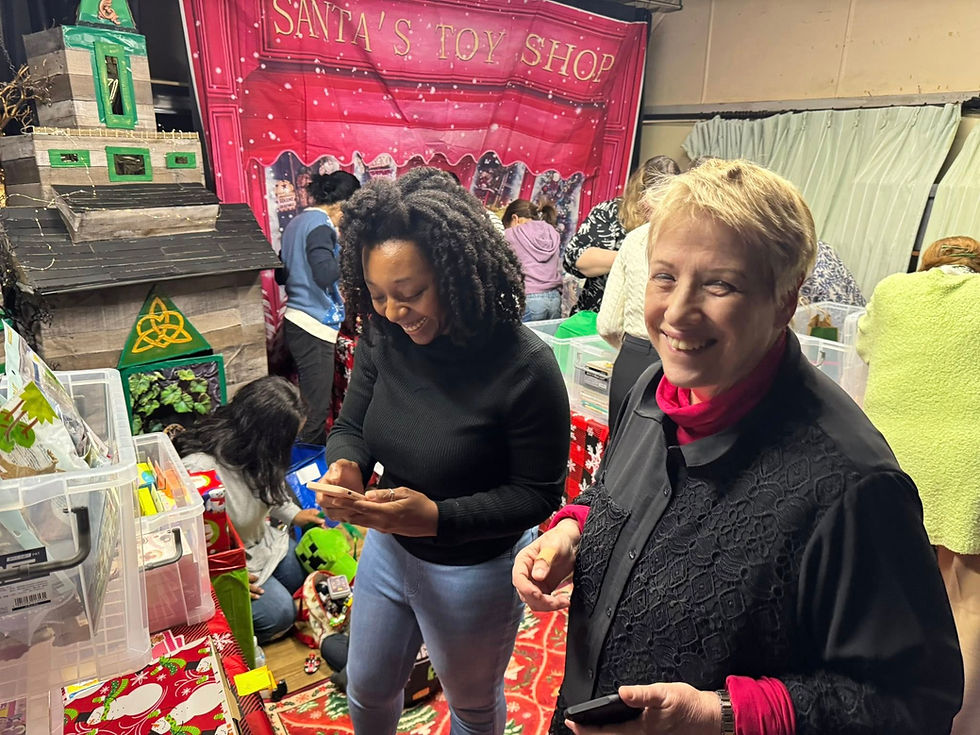
Lauralee: Our primary hands-on project is partnering with YouMeWe to provide Christmas gift boxes for approximately 60 foster children at an orphanage in Tokyo. These boxes include hygiene items, stationery, and toys. This is our most labor-intensive annual project.
While we do not currently have enough volunteers to expand to another orphanage, we hope to grow through partnerships with organizations that have volunteers but lack funding.
Jasmine: What is one of the most challenging aspects of DAR?
Lauralaee: One of our greatest challenges is recruiting new members who can help sustain and expand our work.
Jasmine: Does DAR have any upcoming events?

Lauralee: Our next planned event is our annual Christmas gift box packing session.
Jasmine: How do people get involved with DAR?
Lauralee: DAR is a lineage-based organization open to any woman aged 18 or older, regardless of race, religion, citizenship, or ethnicity, who can prove lineal descent from an ancestor who aided in achieving American independence.
This includes patriots from France, such as the Marquis de Lafayette and Comte de
Rochambeau, as well as individuals connected to Spain, including General Bernardo de Gálvez and residents of Spanish Louisiana (Nueva España).
DAR also maintains a database of more than 6,500 Patriots of Color, including individuals of
African, Native American, Iberian, Latin American, and multiracial ancestry.
We have volunteers who will help with research in proving lineage, allowing for membership.
Many are surprised to learn of their connections. To become a member or have questions
please contact the Sasebo Chapter sasebo.corrsec@gmail.com or a local chapter throug the
DAR website at DAR.org.
Jasmine: Have you participated in Giving Tuesday before?
Lauralee: The National Society DAR in Washington, D.C., has worked with Giving Tuesday for
approximately 14 years, so we were familiar with the organization. However, we were unaware of Giving Tuesday Japan until being introduced by Michael Perry-Clemons from YouMeWe.
Giving Tuesday Japan has already supported us by assisting with gift box packing. April Dykes was especially helpful in locating pre-printed boxes that do not require wrapping, saving us significant time and effort.
Our greatest need is new membership to help expand our service in Japan, particularly for
children in need. We are deeply grateful for the opportunity
Want to share your story? www.givingtuesday.jp/contacten


コメント