


Sushidoro Shouraku Spotlight Interview with Miyuki Endo - #MyGiving Story


While in Japan, I experienced so many new wonders alongside beautiful simplicities. From breathtaking rural views to bustling cityscapes to astounding temples, I found myself immersed in a rich culture every single day. However, one of my favorite experiences by far was participating in a neighborhood event at my housing accommodation in the tranquility of Kamikitazawa.
The event is called Kodomo Shokudo (子ども食堂 ), also known as the “children’s cafeteria”. Every month, my housing accommodation, Kamikita House, holds this event to celebrate the birthdays of the neighborhood kids that month. However, none of this would be possible without the compassionate and resilient work of Miyuki and Yoshiaki Endo, who own a sushi restaurant, Sushidoro Shouraku, that caters the event. Miyuki’s passion for her community and her work is as striking as a ray of sunshine after a rainy day, and I am very grateful to have had the opportunity to interview her.
We at Giving Tuesday Japan had the exclusive opportunity to interview Miyuki about why she does what she does, what inspires her to give back, and what her and the shokudo's future goals are.
Take a look at the My Giving Story interview between Miyuki and our Giving Tuesday Japan Content Intern, Unique, below!
--------

Unique: Hello Miyuki, it is nice to talk to you again! Please introduce yourself, your business, Sushidoro Shoraku, where you are from, and your background in the business!
Miyuki: Hello. My name is Miyuki Endo and my husband is Yoshiaki Endo. We were born and raised in Tokyo. We run Sushidokoro Shouraku, a family-owned sushi restaurant in Shimotakaido, Suginami Ward, Tokyo, that has been in business for 58 years. My husband’s father opened this restaurant, and my husband began training there after graduating from high school, gaining experience as a sushi chef.
I grew up in my parents’ electronics store in the same shopping arcade, and by some twist of fate I ended up marrying into a sushi restaurant. Now, in addition to running Sushidokoro Shouraku, we’re also involved in events held by the shopping arcade and store owners, and we also run an event known as the “Town's Birthday Party”. Established as an unincorporated association in June 2023 and holding its first event in the same month, it’s a special version of “Kodomo Shokudo”, a children’s community meal program.
As a community-based sushi restaurant, we not only serve delicious food, but also try to be a place that fosters connections between people.

Unique: You and your husband cater for Kodomo Shokudo once a month at the Kamikita House in Kamikitazawa, what inspired you to become a part of this? How big is your role in participating in these events? What do you hope people gain from these events?

Miyuki: The ”Town's Birthday Party” [Kodomo Shokudo] is an event held each month. We invite all children with a birthday that month, along with their friends and family, to come celebrate together. In months when few children participate or have birthdays, we also invite elderly people in the neighborhood with a birthday that month to come celebrate, too.
The meal for the “Town’s Birthday Party” is provided by community-based restaurants that bring their signature dishes. People from various professions active in the community decide the celebration's activities. They entertain attendees by using their skills and specialties. In the past, guests have enjoyed performances by a Japanese dance teacher, communication magic by a magician, a mini cello concert, and the birthday children even had a chance to get their hair styled by a professional hairdresser.

Our event has only been made possible thanks to KAMIKITA HOUSE, a venue that encourages community and multicultural activities. What started as a small idea has become a great gathering for the children and their families in our community, and has far exceeded anything we had ever imagined.
I was inspired to start this initiative when my daughter was in elementary school. A girl in her class suddenly became a young caregiver, drastically changing her daily life and living environment. For children like her, not only such circumstances, but also their family’s financial difficulties and abuse in the home can dramatically change children’s lives. [In Japan,] however, it’s difficult for schools to be deeply involved with families due to privacy issues. Thus, the reality is that necessary support often doesn’t reach those who need it most.
From this experience, I began to think that it was necessary for us adults to watch over children not only at school but also in the community. If restaurant and shop owners in the shopping arcade, staff, and other volunteers greeted and talked to the children regularly, they would become a consistent and friendly face to the children in the community. By doing this, the adults of the community would be more likely to notice even small changes, which could help prevent isolation. My husband and I don’t just serve food; we also bring local restaurants and volunteers together to create a place where children and their families can feel safe.

Through these initiatives, we want to foster a community where people from children to the elderly can connect and support each other across generations and positions. More than anything, I wish for children and their guardians to feel that there is somebody who cares about them in the community.
Unique: Do you cater for any other events? How long have you been involved in organizing community events?
Miyuki: Before we started the “Town's Birthday Party”, we had no idea what was needed or where to even begin for such an event, so we visited several organizations that run children’s cafeterias in Suginami Ward to hear what they had to say. Everyone has been figuring out what ways work best for them to continue their work, and I’ve learned so much from them.
In turn, after we started our event, some groups have come to observe our activities, and little by little, we have created relationships where we can learn from one another.

We’re focusing all our efforts on organizing the “Town’s Birthday Party” at the moment, so we don’t offer catering services for other events. However, I don’t believe that activities such as this that connect the community are something that a single organization can perfect. Rather, it’s something that each local community must nurture on its own through its shops and residents.
Unique: Do you have any goals you would like to achieve through community events such as Kodomo Shokudo? How important is community involvement to you?
Miyuki: Through our community events, our goal is to create a society in which people in the community connect and look out for each other.
In the past, towns were full of private shops such as fishmongers, vegetable shops, bakeries, and butchers. Because they weren’t chain stores, the owners knew their customers personally, so it was common to hear things like, “We got some fresh fish in today,” and “I haven't seen you around lately—how have you been?” These casual conversations were a part of everyday life, making stores a place to gather, talk, and shop.
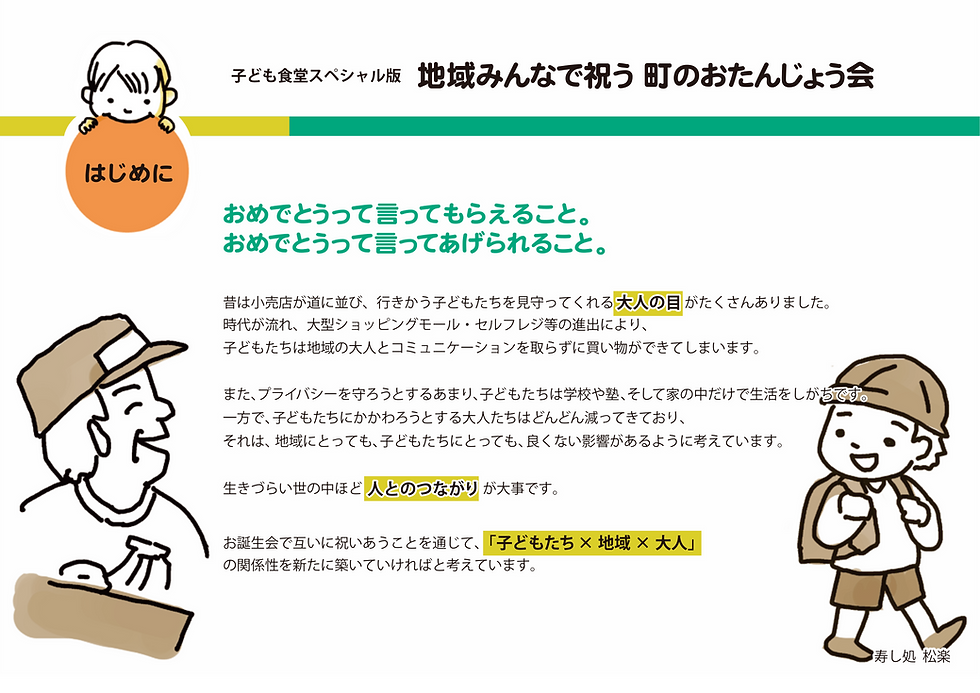
However, with the rise of large-chain supermarkets and convenience stores, and the shift to cashless payments, life has become more convenient but also more secluded. Because of this, now more than ever, it’s possible to go a whole day or even days without actually making conversation with anyone. This situation also gives children fewer opportunities to hear adults say things like “Thank you,” “You’ve grown so much,” or “You’re doing a great job,” so their ties to the community have become weaker than before. As a result, I feel we’ve become a society that’s less likely to notice changes in people such as those who have become isolated, or children or families who are struggling.
That's why we believe that a community-based family-owned store like ours has a role to play in reconnecting people. Over time, I’m positive our efforts will foster connections with the customers who support our store and ultimately ensure trust in us by the local community.
At first, I considered starting something like a children’s community cafeteria, but quickly realized dishes from sushi and specialty restaurants weren’t good options for daily meals. Around that time, my son’s friend said, “Sushi is something you eat on your birthday”. The moment I heard those words, it dawned on me. If that was the case, then why didn’t we all get together as a town to celebrate the children’s birthdays!

At the birthday party, cakes from pastry chefs, sushi from sushi chefs, roast beef, sandwiches, and more are made with love and care by various shops, creating a wonderful feast. We hope the day becomes a special birthday memory for the children as local professionals offer their congratulations.
The message I most want to tell the children is this: There are people in your community who care about you and are happy to see your growth. And if or when you stumble in life, your town will always be one that remembers you and one that you can always return to.
My hope is that someday when these children become adults, they will become supporters of others, and the cycle of community compassion will continue.
Unique: How long has your restaurant been in operation? Is it a family business? Do you have multiple locations, or are you local?
Miyuki: Our restaurant has been in business for 58 years. It's a family-run restaurant inherited from my late husband’s father.
Unique: What kind of food do you specialize in making?

Miyuki: We take great pride in our traditional Edomae-style sushi.
Our conger eel is particularly popular. For 58 years since we opened, we’ve served it coated in our house-made sauce, which we’ve carefully preserved and replenished over the years. It’s characterized by a deep umami flavor cultivated over many years.
In addition, our in-house grilled tamagoyaki, vinegar-marinated fish, and kanpyo rolls are also beloved by many of our customers. While these dishes may seem simple at first glance, flavors and preparation methods vary from restaurant to restaurant, making them dishes that truly reflect each chef's skill and individuality.
We cherish the Edomae-style sushi techniques passed down through generations and serve each dish with the utmost care and dedication.
Unique: Where is Sushidoro Shoraku located? How can people find it?

Miyuki: Sushidokoro Shouraku is located at 3-15-13 Shimotakaido, Suginami Ward.
We sometimes have customers from overseas who’ve said they found our restaurant while searching for sushi restaurants on Google.
Unique: Why should both locals and visitors stop by your establishment? What kind of experience do you hope they will have?
Miyuki: Our restaurant is not in a tourist spot or bustling downtown area. It is a small sushi restaurant that stands alone in a quiet residential neighborhood.
In the past, this area used to be a lively shopping district lined with many small, independently-owned businesses. However, as times have changed, many of those shops have closed, and now there are fewer and fewer traditional neighborhood sushi restaurants like ours. Our restaurant isn't very spacious, so we sometimes have to turn customers away when we're full. Even so, we cherish the time we spend with each guest so that they’ll feel it was worth coming.

For locals, we hope to be a place where they can feel at ease and ‘come home’ to. For those visiting Japan for the first time, we would be delighted if our restaurant became the place where they experienced the feeling of everyday life, community, and warmth of a Japanese town—something you can’t find at typical tourist spots.
We hope that along with our sushi, you’ll also feel the connections we share with the people who live in this town and our commitment to cherishing the community.
Unique: Are you interested in volunteering for any other community events? Do you have any projects in mind right now?
Miyuki: I’m very interested in community activities. However, since I run a sushi restaurant, balancing these activities with my business hours makes it difficult for me to travel to other areas and participate regularly.
Instead, we hope to build up our efforts one step at a time right here in the community where we live and run our restaurant.
One of the things we’d like to achieve right now is to create a learning space similar to a “terakoya”, or traditional Japanese temple school.
While regular schools have specific subjects that must be learned, there are few opportunities to hear fascinating stories about daily life and work—such as
“Why is fish so delicious?”, “How does electricity reach us?”, or “What is the history behind kimonos and music?”

Our community is home to many artisans, professionals, and people with diverse backgrounds who have been working here for many years. I hope to create a space where such people can share their passions and talents with children.
Unique: Do you ever confront any challenges when it comes to organizing community events, and if so, how do you overcome them?
Miyuki: I’ve never felt that hosting the “Town’s Birthday Party” was challenging. Rather, I was more worried about whether the time people were spending at the events was leading to connections between them.
There is one instance at one of our events that has left a lasting impression on me. One child looked at the banquet food and said, “Wow, all of this is free!” I think those words reflected that child’s genuine surprise. However, when the child said that, we reflected on our purpose, asking what it was that we really wanted to give to people through these events.
More than the offering of free food, what we really want to share with everyone is our spirit—the dedication of the chefs and staff at each restaurant, who start preparing early in the morning and put their hearts into making their specialties, all with the desire to “celebrate the children.”

Usually, when we see dishes at a restaurant, we rarely have the chance to learn about their background. So we plan to film the cooking preparation and process, and show the footage at the event venue. We want to provide not only the food but also the thought put into each dish.
Another challenge was to create an environment where everyone could interact naturally with one another. Just because it’s an event doesn’t mean it's easy for people to strike up a conversation with someone they’re meeting for the first time.

That’s why I came up with a game called “Name Bingo”. It’s a game where children, adults, local volunteers, and international students all ask each other their names to complete their bingo cards. International students are asked to speak to everyone else in their native language, and those who can use sign language are asked to introduce themselves in sign language, so that they can interact with each other by making the most of their individuality.
Today's children have fewer opportunities than before to talk comfortably with adults they don't know. However, we’ve noticed that thanks to the fun atmosphere created by the games, even the children who are nervous at first begin smiling, and as they relax, will start approaching the staff and other participants on their own.
Unique: What are the best ways in which the community can participate in Kodomo Shokudo, if they can?
Miyuki: I believe that community building isn’t about doing something grand, but rather about gradually building up these small conversations and encounters, one by one. We hope to continue fostering a space where everyone can connect naturally, while always valuing the feedback of our participants.
I also don’t think building a community is something only special people can do. So far at the “Town’s Birthday Party”, chefs have prepared the food, musicians have performed, a Japanese dance instructor has given a demonstration, and a hair and makeup artist has styled the children’s hair. Some international students play with the children, while others help with reception duties and setting up the venue.

In other words, I believe that everyone, no matter what, has something they can contribute, and that is what participation is all about.
You don’t have to have a special skill. It’s wonderful enough just to have someone who talks to the children, plays with them, or helps set up and clean up the venue.
Each individual in a community has the ability to help others, and when all that support comes together, the children can truly see and feel that there are people in the community who are supporting them.
Unique: What are some ways in which both locals and visitors can give back to your business or the events you plan?

Miyuki: Of course, we’re always very happy when you stop by our restaurant. However, what personally makes me even happier is when the people who share our vision for this initiative also value their own connections with others in their own communities. For example, shopping at local stores, striking up conversations with neighbors, keeping an eye on the children, and participating in community activities in whatever way you can are all ways to support and strengthen community ties.
Unique: Before we contacted you, did you know about Giving Tuesday? Or have you participated in it? Is there anything you would like to do in collaboration with Giving Tuesday in the future? How can we (Giving Tuesday Japan) support either Sushidoro Shoraku or the Kodomo Shokudo events in the future?
Miyuki: I didn't know much about Giving Tuesday until you contacted me.
However, once I learned about your philosophy of everyone having the power to take action in helping others in whatever way they can, I felt that it was very much in line with the kind of community we are striving to build.
In the future, we hope to expand and increase opportunities to participate together in community activities for local and larger businesses, residents, students, and international students.
I believe especially that when international students become involved in the local community and interact with children and the elderly, it plays a major role in helping both sides learn about each other’s cultures and in creating new connections within the community.

If there’s one thing we could ask of Giving Tuesday Japan, it would be to help spread the word about these kinds of activities and connect people who want to get involved in their communities or support such efforts with local initiatives like ours. Support like that would be a huge source of encouragement for us.
Lastly, nothing would make us happier than for our activities to serve as a model for others to help spread a culture of celebrating children together as a community throughout Japan.
Want to share your story? www.givingtuesday.jp/contacten


Heartwarming.